The 2027 traveler wants to go off-script. Goiânia just made the shortlist
Booking.com’s 2027 predictions describe trips led by mood, rest and surprise. Seen from Latin America, the map says even more.


Every autumn the big travel platforms publish their predictions for the year ahead, and every autumn I read them with the same mix of curiosity and caution. Curiosity because they are built on enormous samples and occasionally catch something real before the rest of us notice it. Caution because the company publishing the forecast usually sells the solution to the trend it has just discovered.
This year’s edition from Booking.com, its eleventh, is a good example of both, and I think it is worth reading closely, because buried inside the playful labels is a fairly serious portrait of how people now want to move.
The headline is that travel in 2027 is going off-script. According to Booking.com’s 2027 Travel Predictions, trips will be led by mood, shaped by budget and defined by surprise. The research behind it is substantial, more than 28,000 adults planning business or leisure travel across 32 markets, surveyed in July and August 2026, including around a thousand respondents each in Brazil, Argentina, Colombia and Mexico.
Paul Hennessy, the company’s chief marketing officer, summed it up neatly: travel is becoming “less about following a formula and more about expressing who you are.” I agree with him. I also notice that the formula he is retiring is the one that made online travel agencies rich, and that the replacement he is describing, personalized by AI, is the one his company is building. Both things can be true, and the data is still worth our time.
Mood is the new itinerary

The most striking numbers in the report are about how people decide where to go. Eighty one percent say they would choose a destination based on how they want to feel, with the place itself almost a detail. Seventy six percent would use a tool that recommends places based on their mood or emotional state, and among Gen Z, 76 percent say they would share wearable data, phone metrics or even their emotional state with a travel provider, against just 35 percent of boomers.
Add to that the 77 percent who are interested in a trip that lets them do something completely out of character, and the picture becomes clear. The destination is turning into a means. The feeling is the product.
I find this both obvious and quietly radical. Obvious, because anyone who has ever booked a beach to recover from a brutal quarter already knew it. Radical, because the whole architecture of travel search was built the other way around, starting from a city and a date and working backward to a price. A traveler who starts from “I want to feel calm” or “I want to feel brave” breaks that architecture, and the companies that learn to search by intention rather than by airport code will win the next decade.
It is the same instinct I have written about before, that the traveler was never really asking for another app to fight with. They were asking to be understood. A Gen Z traveler offering their heart rate to a booking engine is simply the most literal version of that request I have seen.
There is a commercial edge here worth naming. A mood-matching tool is exactly what a platform like Booking.com wants to sell, so the 76 percent should be read as genuine appetite filtered through a very interested question. The appetite is real. The enthusiasm for handing over emotional data deserves a second, more skeptical look, especially from anyone who manages travel on behalf of a company and carries the responsibility for what that data touches.
The vacation still has a laptop in it
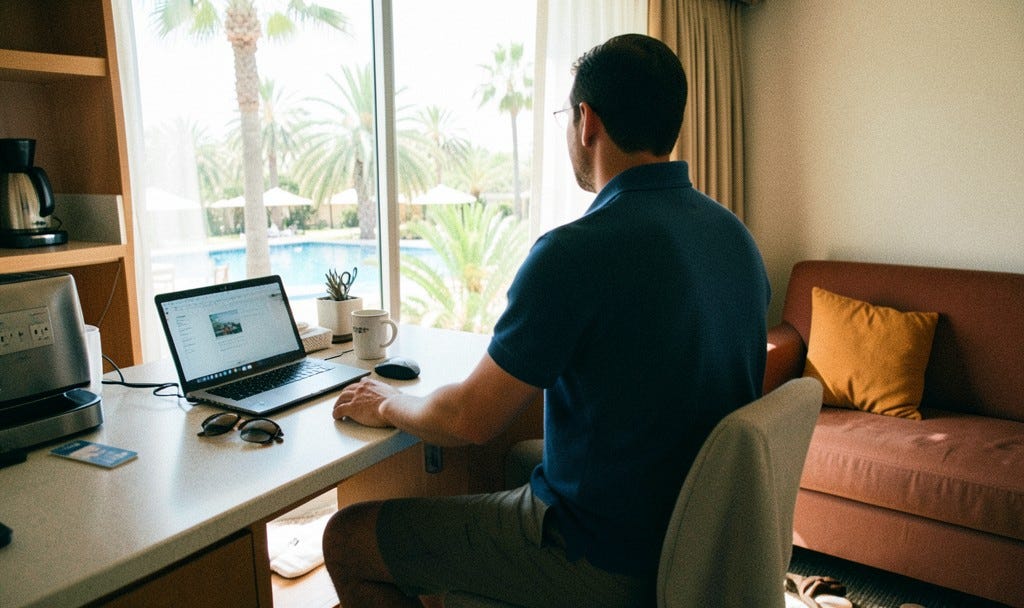
The prediction that hit closest to home for me is the one Booking.com calls PTO: Powered by AI, and it is less a forecast than a confession. Fifty eight percent of travelers say the last day of their vacation is less enjoyable because they are already thinking about going back to work. Thirty eight percent bring a laptop to keep up with their inbox. And 64 percent are interested in having AI cover their work while they are away, with 43 percent comfortable letting it manage email and admin, and 44 percent saying they would use it to catch up on missed work, effectively buying themselves an extra day off.
I recognize myself in every one of those numbers, and not proudly. On my last vacation I spent a full week working from the destination, from a comfortable extended-stay hotel room designed precisely for people like me who never quite manage to leave.
The room was lovely. The inbox came along anyway. What the data describes is a labor trend wearing sunglasses, the final dissolution of the line between the business trip and the holiday. And the solution people are reaching for is exactly the one I spend my working life on, which is letting software carry the routine so the human can actually be somewhere. It is the same conviction behind something I wrote about hotels, that the best moments in travel still depend on human attention, and attention is precisely what an inbox steals.
Full disclosure, since this is my territory: the corporate travel and expense platform I co-founded builds AI agents that take repetitive work off people’s plates, so I have an obvious interest in this prediction coming true. The more interesting point, though, is a human one. If two thirds of travelers want a machine to guard their time off, they are telling us that the scarcest resource in modern travel, scarcer than any flight or room, is presence.
The traveler who arrives in Lisbon but stays mentally in a spreadsheet has not really traveled at all, and the technology that gives that person their attention back is selling something far more valuable than convenience.
The flight is becoming the first night of the hotel
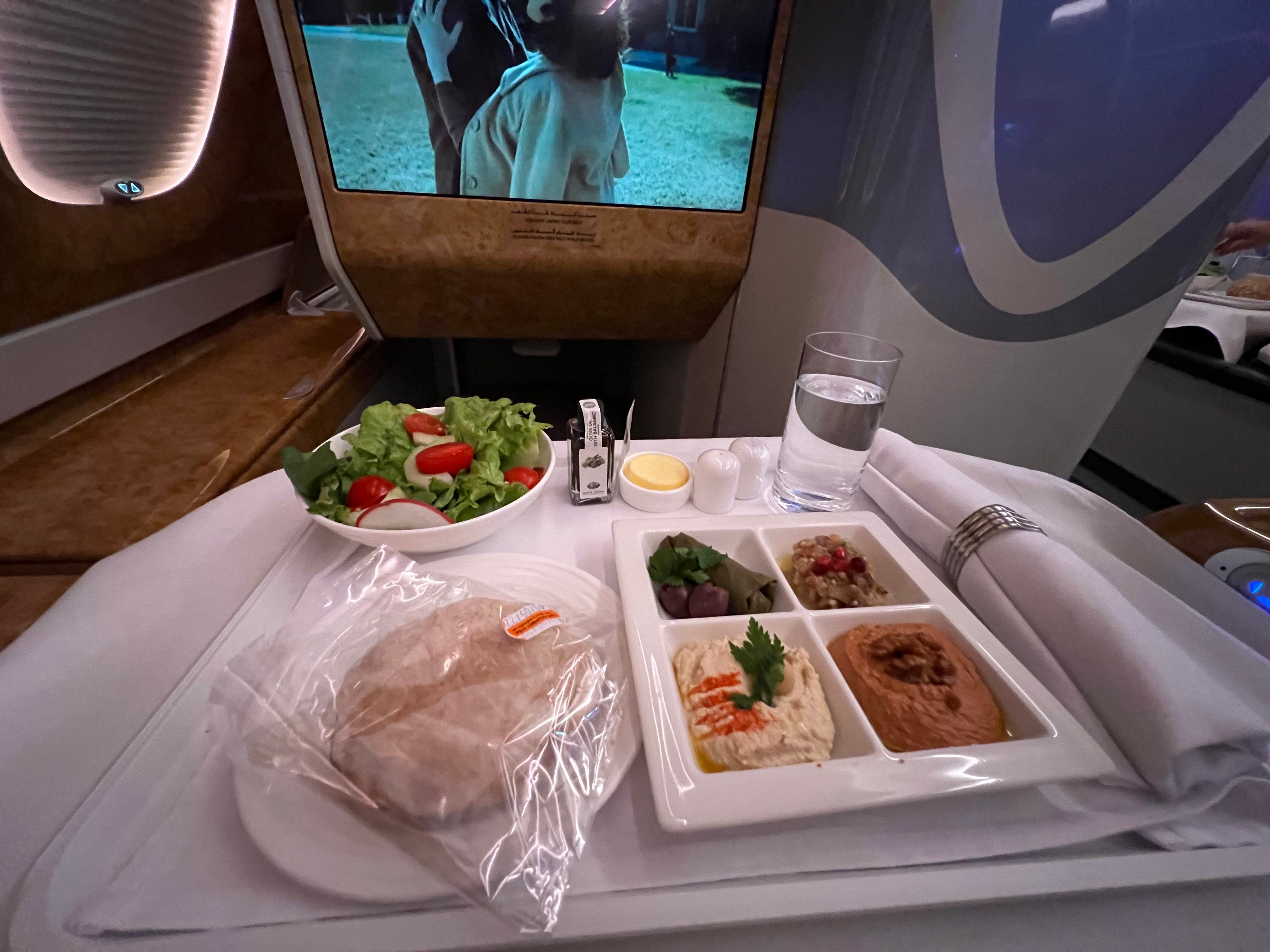
The prediction Booking.com calls Hotel in the Sky will delight every aviation geek, and I am a card-carrying member. The headline figure is that 89 percent say they would take a long-haul flight if it guaranteed they would arrive rested and refreshed, and in the infographic version the same share says an airline’s ability to deliver that would influence which carrier they choose. A third want food, drink or caffeine timing designed around sleep, one in five want lighting to reduce jet lag, and nearly a quarter would choose a designated quiet, child-free zone on board.
For business travel this belongs in the productivity conversation, far more than in the luxury one. A sales director who lands in Madrid exhausted after a night flight from São Paulo is a worse negotiator the next morning, and every travel manager who has ever argued for a better cabin on a long sector has been making exactly this case, usually without the data to prove it. The industry has spent decades turning distance itself into a solved problem.
The next frontier is arrival, and the airlines that sell rest as a measurable outcome rather than a seat width will find a very receptive audience in finance departments that finally understand what a lost morning costs.
Solo, but not alone

Two of the predictions read almost like a sequel to a reflection I wrote recently about how much of our social life we now outsource to travel. Booking.com finds that 66 percent of people who have traveled alone say a shared physical activity or challenge led to a lasting connection or friendship, and 55 percent would like to join a community of like-minded people while traveling. In the same spirit, 81 percent say at least one holiday activity makes it easier to have honest or difficult conversations with a partner, and the single most effective activity, cited by 35 percent, is simply walking together.
There is something lovely in that last number. In an age of extraordinary travel technology, the most powerful tool for human connection on a trip turns out to be a long walk. It reminds me why I have always found airports and hotels such generous places, one of the safest places I know is a departure lounge, precisely because they put strangers side by side in a shared moment. And because no predictions report would be complete without one delightfully strange entry, Booking.com also finds that 65 percent are interested in paranormal, horror or gothic experiences, and nearly half would seek a trip in the hope of speaking to someone on the other side. I will leave that one to braver travelers. My own spiritual practice on the road is a long hotel breakfast at the corner table with the best light.
The map is moving to second cities
The companion piece to the predictions is Booking.com’s list of trending destinations for 2027, and it is here that the report gets genuinely interesting for anyone who thinks about where business and leisure travel are heading. The list is almost entirely made of second cities and quieter alternatives to the obvious hubs: Sendai instead of Tokyo, Reims instead of Paris, Pescara on Italy’s quieter Adriatic coast, Bratislava between Vienna and Budapest, Monterey on California’s Central Coast, Puri on the Bay of Bengal, Christchurch rebuilt after its earthquakes.
That pattern matters more than any single name on it. It suggests travelers are tired of the same ten crowded skylines and are looking for places with character, space and a slower rhythm, which fits neatly with everything else in the report, the mood-led choices, the hunger for surprise, the desire to arrive rested.
For hotels and airlines, it is a quiet warning that demand is spreading out across the map, and that the next growth will come from cities that the big distribution systems have historically treated as afterthoughts. The value, as so often in this business, is hiding in the structure underneath, in the connectivity, the hotel supply and the local partners that make a second city easy to reach.
Goiânia, Asunción, Rosario: Latin America turns trendy

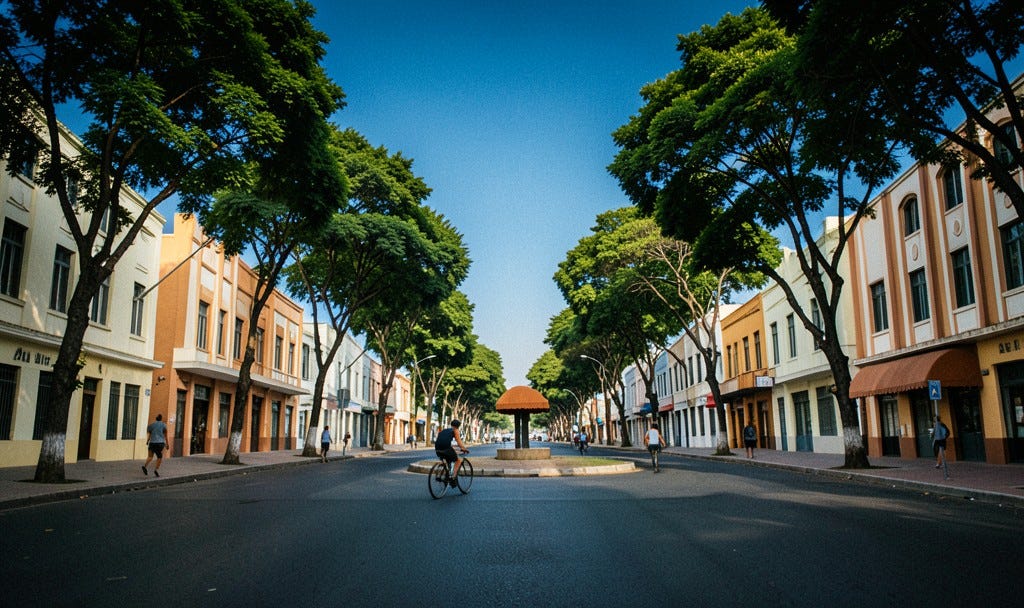
And then there is the part that made me smile at my desk. Three of the ten trending destinations for 2027 are in South America: Goiânia in Brazil, Asunción in Paraguay and Rosario in Argentina. Not Rio, not Buenos Aires, not Cartagena, the usual faces on the postcard. Three second cities, each chosen for exactly the qualities the rest of the report celebrates.
Goiânia, as Booking.com describes it, is a planned city built in the 1930s, with wide boulevards, art deco architecture and a rich Cerrado culture. I would add, from the business side, that it is also the capital of one of Brazil’s great agribusiness heartlands, which means a good share of the people flying in are already there for work and staying for the food. Asunción gets its due as an unhurried capital on the Paraguay River, with pastel architecture, sprawling markets and a lively cocktail scene. Rosario, on the Paraná, is described as a creative city with a long riverside promenade and a strong neighborhood culture.
I find this deeply encouraging, and not only out of regional pride. For years the global travel conversation has treated Latin America as a handful of famous cities and a lot of empty space in between. A list like this suggests the world is beginning to see the in-between, the interior capitals, the river cities, the places that live their own rhythm. It fits the stubborn optimism I keep returning to about why this region is such a good place to be building right now.
Our second cities are where much of the region’s real economy lives, and they are finally being discovered by travelers who want precisely what they offer. The opportunity for the region is to make them as easy to reach, book and enjoy as they are interesting.
What this means for the business traveler
Read as a whole, the 2027 predictions describe a traveler who wants to feel something, rest properly, connect with others and escape the inbox, and who is willing to let technology help with all four. It is tempting to file this under leisure and move on. That would be a mistake. The business traveler is the same human being, carrying the same fatigue, the same longing for presence and the same suspicion that the trip would be better if someone else handled the admin.
For those of us who design corporate travel programs, the lesson is that policy alone will no longer satisfy people who are learning, in their personal lives, to expect travel that adapts to them. The programs that win will be the ones that protect rest on long sectors, make room for a little of the off-script joy that turns a work trip into a memorable one, and let AI absorb the repetitive tasks so that the traveler can actually show up, mentally as well as physically.
None of that is in tension with cost control. It is, I am increasingly convinced, the experience travelers refuse to give up, and the companies that respect it will find their people travel better and come back more productive.
Booking.com is right that travel is becoming less about following a formula. My only addition, from the corporate side and from the Latin American side of the map, is that the people writing the new script are not only vacationers chasing a mood. They are also the sales director who needs to land rested in Madrid, the analyst who wants their week off to actually be off, and the traveler about to discover that Goiânia was worth the trip all along.
About me

I am an entrepreneur with over 20 years of experience at the intersection of tourism and technology. I am co-founder and Chief Business Officer of VOLL, the largest mobile-first corporate travel and expense management platform in Latin America, where I lead the commercial strategy behind our AI adoption.
A first-cohort graduate of The AI-Powered Organization at Stanford Graduate School of Business and a Marketing specialist from Fundação Dom Cabral, I serve on the Tourism Council of FecomércioSP and on the Executive Council of the Latin American Association of Corporate Events and Travel Management (Alagev). I write and speak about innovation, digital transformation, entrepreneurial leadership, and the future of corporate travel.
Discussion about this post