



In 2021, I flew an Emirates A380 for the first time, in business class, from São Paulo to Dubai. Almost 14 hours that, honestly, felt like they flew by. My colleague Caroline Nogueira, now head of VIP services at VOLL, was on that flight with me, and she slept through almost the entire thing, something I am fairly sure she still regrets, given how little of the experience she actually got to enjoy. I remember the seat, the attentiveness of the crew, the strange sensation of being on an aircraft that felt more like a small hotel suspended at 12,000 meters.
Two things stuck with me from that flight. A well-designed experience reorganizes how time feels, what should drag can pass quickly. And excellence is not luxury, it is consistency, the same quality delivered on every route, every time.
I have been thinking about that flight again this month, watching four completely different stories about long-haul travel land in the same news cycle.
None of them are really about the same thing on the surface, a new world record route, a delayed technology bet, a routing partnership through Central America, a redesigned economy seat, but all four are solving the same underlying problem from a different angle: how do you make extreme distance disappear from the traveler’s actual experience, even when the miles themselves do not shrink?
The new record holder starts and ends in different hemispheres of the same ocean

In December 2025, China Eastern Airlines began flying between Shanghai and Buenos Aires, a route that immediately became the longest regularly scheduled commercial flight in the world.
The eastbound leg from Shanghai runs about 25 hours and 30 minutes, the return trip can stretch to 29 hours, and the total distance covered is close to 20,000 kilometers, according to reporting from Aeroin, which covered the route’s commercial launch in detail. The aircraft, a Boeing 777-300ER configured with six first class seats, 52 business and 258 economy, makes a two-hour technical stop in Auckland, refueling without requiring passengers to change planes or clear a full connection.
What makes the route commercially viable is not novelty tourism, it is demographics. Argentina’s Chinese community has grown past 55,000 residents, and the route marks the first regular link ever operated between Shanghai and a South American metropolis, replacing what used to require at least one connection through Europe, North America or the Middle East, as coverage from Rádio Itatiaia laid out.
For a moment, Latin America is not the region aviation history happens to, it is where the record currently sits.
The route also lands in an already competitive corridor. Latam flies Santiago to Auckland, Sydney and Melbourne, and Qantas connects Sydney to Santiago, meaning China Eastern’s technical stop in Auckland puts it in indirect competition with two carriers that already treat the South Pacific as a serious trans-hemisphere market rather than a niche.
Buenos Aires had gone five years without a westbound service to the other side of the Pacific, after Air New Zealand pulled its own Auckland route, according to Melhores Destinos’ account of the route’s history. China Eastern is not just adding a route, it is re-opening a corridor other airlines had already decided was not worth defending.
The bigger technology bet is real, and later than most coverage suggests

Qantas has spent years chasing a genuinely nonstop Sydney to London flight, under the name Project Sunrise, and the milestone that matters most happened just two months ago, not on the route itself but in testing.
In July 2026, an Airbus A350-1000ULR, the ultra-long-range variant built specifically for this program, flew nonstop from Melbourne to Toulouse in 24 hours and 24 minutes, covering 12,460 nautical miles, the longest certification flight any commercial aircraft type has ever completed, as reported by outlets tracking the test in real time. The aircraft carries an extra fuel tank and roughly 1,000 additional nautical miles of range compared to a standard A350-1000, engineering that Qantas has been building toward since 2017.
Commercial service, though, is later than a lot of coverage still implies. Qantas has locked in October 2027 for the first Sydney-London nonstop flights, with tickets going on sale in February 2027, confirmed directly on the airline’s own Project Sunrise page. The nonstop will shave up to four hours off the current one-stop journey, and the aircraft itself is built with unusually low seat density, 238 seats where a standard A350-1000 in other configurations carries closer to 400, specifically to make a day-long flight survivable.
Notably, part of that redesigned cabin includes a new Economy Plus tier, 42 seats with a 34-inch pitch and priority boarding, sitting between standard economy and business. The same instinct showing up at Emirates is showing up here: when a flight gets long enough, the airline stops treating the middle of the cabin as an afterthought.
What I got wrong until I checked the source myself

I originally understood the recent Brazil-Japan connectivity news as a new direct flight, and it is worth correcting that in public, since the actual story is more interesting and more useful for a corporate traveler than the headline version.
All Nippon Airways and Copa Airlines announced a connectivity agreement routing through Panama City that can cut up to 14 hours off a Japan-bound itinerary, but only for travelers departing cities Copa already serves outside São Paulo, Porto Alegre, Florianópolis, Rio de Janeiro, Belo Horizonte, Brasília, Salvador and Manaus. Today, a Manaus-to-Tokyo trip can take nearly 40 hours with at least two stops.
The Panama routing exists precisely because those travelers no longer need to backtrack down to São Paulo before heading north, as Melhores Destinos explained when the partnership was announced. Passengers also get a single baggage check-through to their final destination. What the partnership is not, at least not yet, is a new nonstop flight. ANA does not fly to Panama, there is no direct Panama-Tokyo service today, and while the Japanese and Panamanian governments have been discussing one, nothing has been formally announced.
That distinction matters beyond accuracy for its own sake. This is a third, completely different lever for shortening a long-haul trip, one that requires no new aircraft technology at all, just a smarter alliance and a willingness to stop routing every regional passenger through the same national hub.
China Eastern and Qantas are both spending billions of dollars and years of engineering to add range. ANA and Copa achieved a meaningful chunk of the same traveler benefit, less total time in transit, with a codeshare agreement and a shared bag tag.
The fourth lever is the seat itself
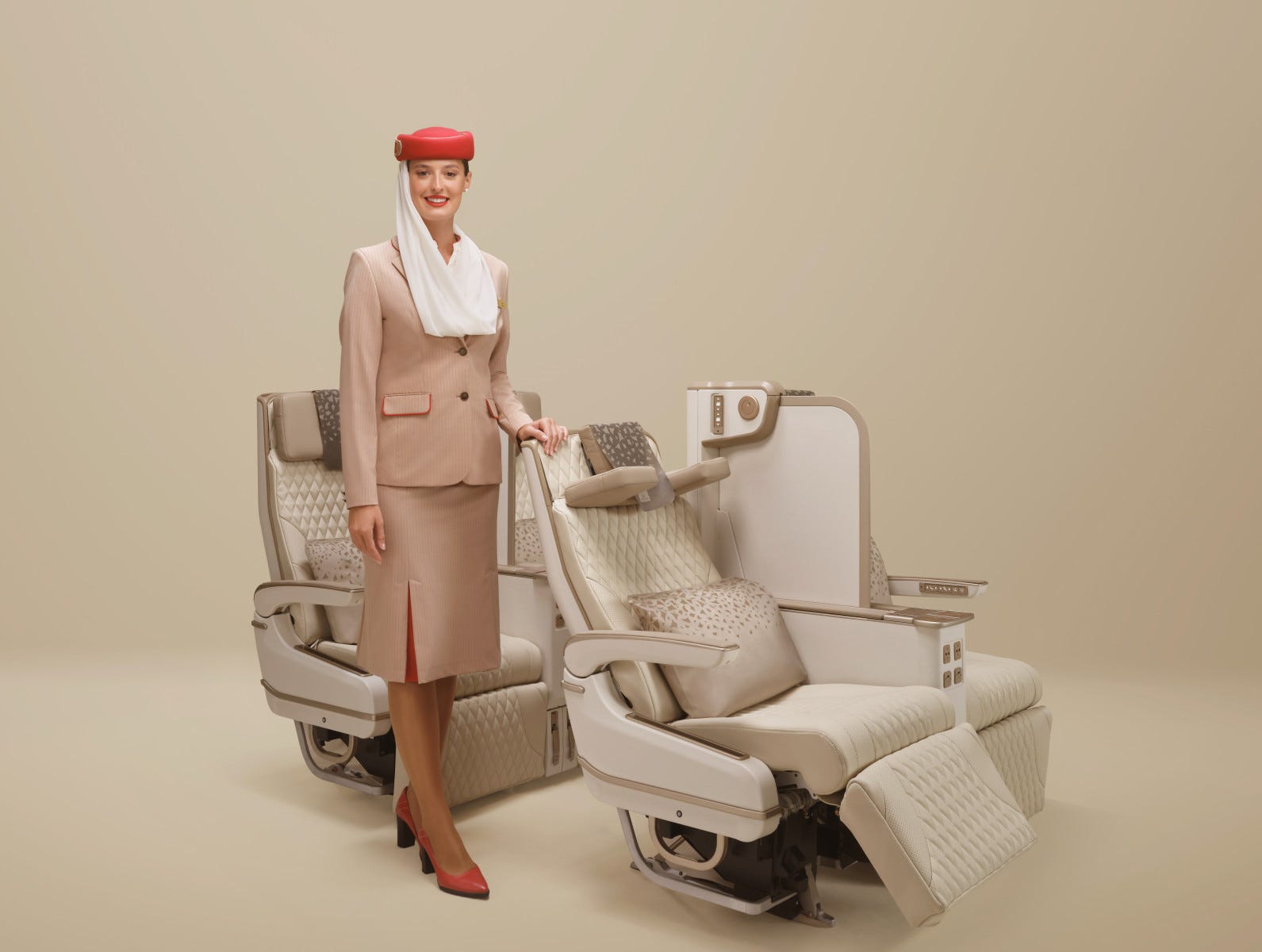
Emirates recently unveiled what it describes as the world’s first electrically powered Premium Economy seat, with a full-height, adjustable privacy divider rising between every seat in the cabin, debuting on the airline’s newly delivered A350s, according to The Business Travel Magazine’s coverage of the launch. The seat itself is 20 inches wide, with pitch reaching 39 inches on the A350, and reclines in a cradle motion designed to keep a passenger from sliding into the seat ahead rather than simply tilting the seatback back.
A deployable leather footrest extends for long stretches of the flight, and the headrest, a U-Dream design built by Safran Seats, wraps further around the head and neck than a standard Premium Economy unit, aimed specifically at making an upright sleep on a long sector less punishing.
The control layer is where the seat borrows most visibly from the cabins ahead of it. A dedicated Passenger Control Unit switches between a lounge mode and a meal mode, adjusting recline and tray position to match what the passenger is actually doing rather than leaving one fixed configuration for the whole flight, a feature set that used to live exclusively in business class.
Wireless charging built into the seat is also new for the airline’s Premium Economy, removing one of the small daily frictions, a dead phone with no free power outlet, that ultra-long-haul travelers deal with more than anyone else on the aircraft.
The world-first claim is Emirates’ own and should be read as marketing until an independent source confirms it, but the direction is not in dispute: the airline is pushing first-class-grade privacy and control technology down two full cabin tiers, onto a seat a meaningfully larger share of a corporate travel budget can actually afford.
For a corporate travel program, that shift matters more on an ultra-long-haul route than anywhere else in the network.
The argument for staying in economy on a two-hour flight and the argument for staying in economy on a 20-hour one are not the same argument, and every feature that closes the experience gap between Premium Economy and Business raises the real question a travel policy has to answer: not whether a company can afford the upgrade, but at what flight duration the case for paying for it stops being a debate at all.
What this means for the policy sitting in a travel manager’s drawer

Most corporate travel policies were not written with a 25-hour or 29-hour flight in mind, because until very recently, that flight did not exist. A policy built around a simple rule, business class above a certain number of hours in the air, starts breaking down the moment the relevant variable is not hours in a single cabin but hours away from a bed, a shower and a predictable meal, which is exactly what all four of the stories above are actually optimizing for.
A route like Shanghai to Buenos Aires raises a real, specific question that a generic policy does not answer: does a technical stop in Auckland, with no aircraft change and no ability to leave the terminal, count as a connection for fatigue and rest-time purposes, or does it count as one continuous flight because that is how the ticket and the boarding pass describe it.
Qantas’s own answer, building an aircraft with 238 seats instead of 400 specifically to make one day-long segment survivable, is itself a policy argument: the airline is betting that removing the stop matters more to a traveler’s actual condition on arrival than removing an hour or two of total travel time would.
A travel program serious about duty of care on these routes should be asking the same question about its own travelers, not assuming a stopover is automatically easier just because it breaks the flight into smaller pieces.
The ANA-Copa story raises the opposite question. It proves a routing change can substitute for a technology change, but it also proves the two are not interchangeable in what they cost a traveler physically. A single-carrier partnership with through-checked bags removes friction, it does not remove the extra hours of layover time or the extra takeoffs and landings that come with any itinerary requiring a change of aircraft, which is a meaningfully different toll on a traveler than 25 hours in one seat, however long that single segment feels.
Four levers, one problem
None of these four stories individually explains what is happening in long-haul aviation right now. Together, they describe an industry attacking distance from every angle it has available at once: China Eastern proving a route that would have been commercially unthinkable five years ago now pencils out, Qantas spending on raw aircraft range even as its own timeline slips by a year, ANA and Copa proving that a good partnership can substitute for a good aircraft, and Emirates proving that comfort itself is a technology that keeps getting cheaper to deploy further back in the cabin. None of the four is waiting for the others to finish.
A traveler booking Shanghai to Buenos Aires next year will fly on China Eastern’s answer to distance, not Qantas’s, and a company negotiating its long-haul policy this quarter should be asking which of the four levers actually applies to the routes its own people fly most, rather than assuming one philosophy covers every ultra-long trip on the schedule.
The lesson from my own flight in 2021 still holds, and it applies to all four of these stories at once. The miles do not change. What changes is whether the traveler notices them. The airlines and networks that figure out which of these four levers fits their route, more range, a better partner, or a better seat, are the ones that make fourteen hours disappear. The ones that do not are the ones still measuring the trip in hours instead of in what the traveler remembers about it.
About me

I am an entrepreneur with over 20 years of experience at the intersection of tourism and technology. I am co-founder and Chief Business Officer of VOLL, the largest mobile-first corporate travel and expense management platform in Latin America, and a recognized reference in the development of the corporate travel industry.
A Marketing specialist from Fundação Dom Cabral, I serve on the Tourism Council of FecomércioSP and on the Executive Council of the Latin American Association of Corporate Events and Travel Management (Alagev). A frequent traveler and close observer of human behavior in motion, I write and speak about innovation, digital transformation, entrepreneurial leadership, and the future of corporate travel.