If AI brings well under 1% of an OTA's room nights, why did my hotel booking habit change?
AI assistants still send a sliver of hotel demand, yet the path to a booking is being rebuilt. I saw the old path up close.


Picture a guest standing at a hotel reception counter, phone against one ear, waiting for a travel agency to pick up. The guest says the reservation was made, the agency says it was made too, through a portal I will call XYZ, and the screen in front of me says nothing. No name, no dates, no room. I worked that counter for about four years, and I remember this scene happening many times, with different guests and different portals, always with the same small silence while everyone waited for a reservation that had never reached our system.
I am telling you this because the industry keeps repeating a number, and the number is true. AI assistants still bring a small share of hotel demand. I believe it, and I think the number hides the more interesting story, the route a guest takes before the booking exists. A full disclosure belongs here, since I will describe that route through my own habits: I now book hotels through the app of the company I co-founded, and my company sells hotel stays through its platform. Read my enthusiasm with that in mind, and hold me to the sources.
The number is small, and I believe it

Start with what the data says. According to a recent column on Hospitality Net by Markus Busch, Booking Holdings reported in August that AI assistants such as ChatGPT bring it well under 1% of its room nights. The same column cites Hilton saying that more than 80% of its business is already direct. Both figures are self-reported by companies with an interest in how modest AI looks, and the author says so himself. I repeat them with the same caution.
A second column by the same author, The AI guest is still rare, points to a Bain and Similarweb analysis in which the share of hotel-site visits coming from AI quadrupled in a year and still stayed under 1%. The sample is small, with only three to five sites per category, and I would not build a strategy on it. As a thermometer, though, it is useful: the fever is real and low. Busch writes about distribution for independent hotels and has ties to a hotel connectivity company, so I read his analysis as one informed view, and a column is only a column.
Small can still be moving

Here is why I would not stop at the sliver. Adobe’s AI traffic trends report says that AI-driven visits to travel sites grew 119% year over year in July 2026, and that the conversion rate of those visits was only 1% lower than non-AI traffic. The report also says AI-referred visitors were more engaged and bounced less. Adobe does not publish the number of travel visits behind those figures, so I treat them as direction, not measurement.
Behind the traffic, the plumbing is moving. A spokesperson for Google confirmed in early August a limited test in the United States in which an AI agent books a hotel through to payment, as Hospitality-ON reported. Amadeus is the technical partner in that test, and the article notes that who keeps the customer relationship and who collects the commission remains unresolved. According to Busch, since late August US guests can book hotels inside Google’s AI Mode through ten companies, including Booking.com, Expedia, Hilton, Marriott and IHG, and independent hotels are not on that list. Google told PhocusWire, as Busch reports, that hotels are ranked like ordinary search results and that partners cannot pay to rank higher, and it has not ruled out ads later.
The demand side is moving too. Busch cites Phocuswright research finding that 56% of US leisure travelers used AI for at least one trip in the previous twelve months, up from 43% in the second half of 2025, and that about half of the travelers who read AI answers in search still click through to the source afterward. The click-through matters to me. It suggests that the assistant is becoming the place where the choice is narrowed, while the hotel’s own page remains where many people go to confirm it.
I wrote in August about what happens when Google lets AI book your hotel and researchers show the agent can be tricked, so I will not retell the security side here. What interests me today is the opposite question: what if the share stays small and the path changes anyway?
The front desk was a map of distribution

Let me take you back to that counter, because it taught me what distribution looks like from the inside. In my years at a five-star hotel in Belo Horizonte, from 2007 to 2011, I could read the origin of a guest from the way they arrived. Some had booked on the hotel’s own website. Some came through online travel agencies. Some came through the systems of corporate travel agencies, and others through national or international tour operators, often as part of a package sold by an agency that I would never meet.
Belo Horizonte is a gateway for the historic cities of Minas Gerais, so the hotel also received road groups of 100, 200, even 300 people, who spent one or two nights in the capital and then continued to Ouro Preto, Tiradentes and Diamantina. Each of those channels had a different rhythm, a different contract and a different way of telling us who was coming.
The hotel’s challenge was to connect with all those providers and channels to receive the reservations. In those years, the systems were not so integrated. A guest could book on the hotel site, on an online portal or through an agency, and the reservation was not automatically mirrored in our property management system, the PMS that runs rooms, nightly rates and daily operations. Internet connections were slower, content distribution was less advanced, and hotel distribution, which has always been heavily intermediated, was more intermediated then than it is today. I remember guests waiting at the counter, calling the agency that said it had made the booking at the portal. I have written about why hotels are where corporate travel really happens, and those silent minutes at the counter were my first lesson in that.
Today the booking arrives before the guest does
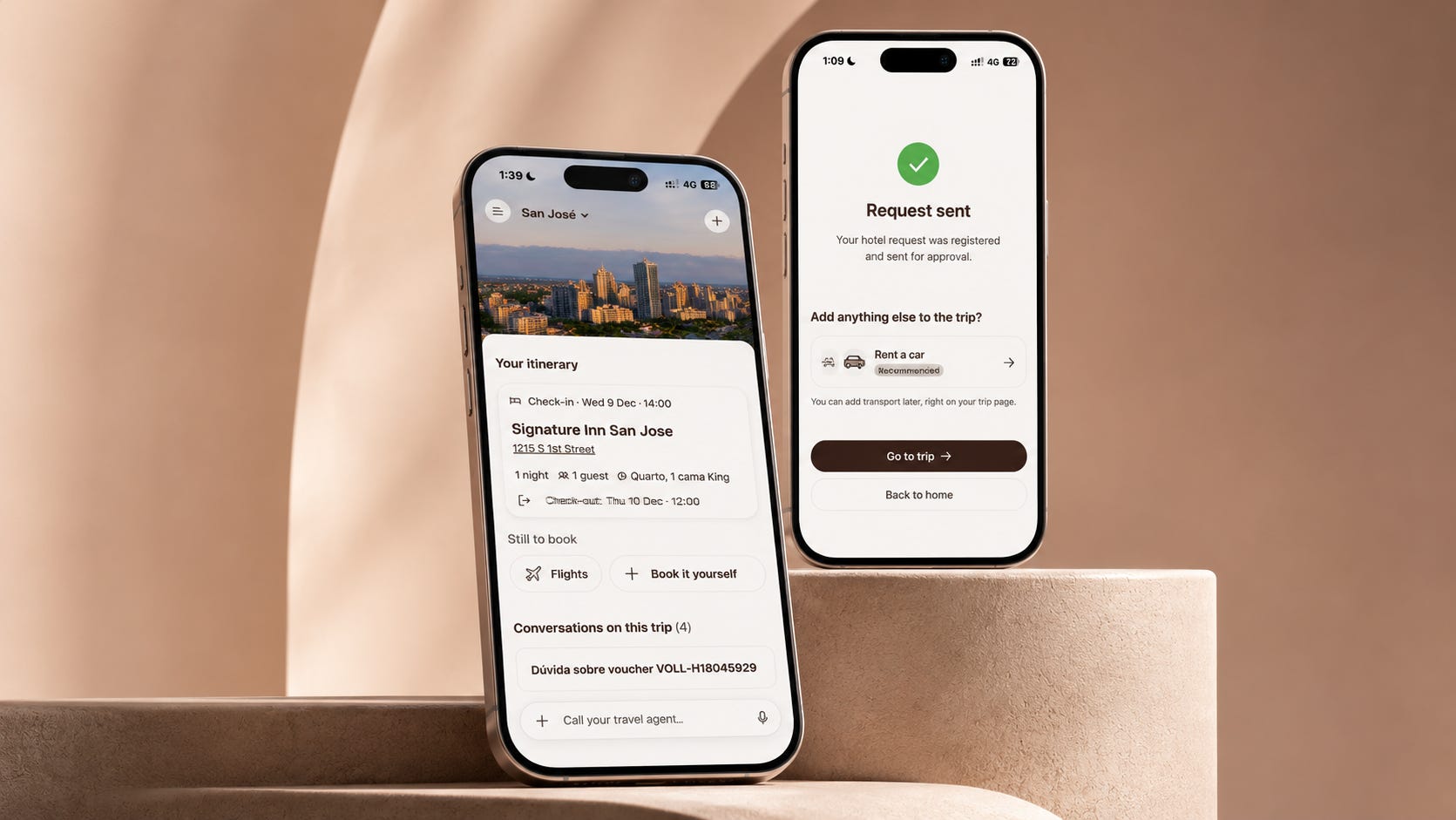
The picture has changed in a way I find almost funny. Today I know that systems exist that connect automatically: when a booking is completed in an app such as VOLL’s, it can already be in the hotel’s PMS within the same second, and the reception can welcome the guest and run the check-in right away. That was not the reality in 2007 or 2011.
I want to be careful not to oversell this. Not every hotel and not every channel works that way yet, and I do not have a figure for how common it is in Latin America. What I can say is that the progress here lives in quiet infrastructure, far from any flashy product. I wrote in the past about what the traveler actually wants from an app, and the answer often comes down to something this plain: the reservation exists, everywhere it needs to exist, before anyone has to ask.
What changed for me was the route

Now to my own habit, which is the reason for the title. I should say up front that it is a sample of one. Until recently, I searched for hotels on the usual portals: Booking, Trivago, Expedia, Airbnb, and Google Maps when I wanted to see a hotel in relation to a specific location. Then, because I hold status in Hilton Honors, Marriott Bonvoy and Hyatt, I often booked through the loyalty portals of those chains, where I could earn and redeem points and the booking flow was smoother.
With the new version of VOLL’s app, I connected my loyalty programs to my profile, and the search now takes them into account. The app offers an interactive map and filters that combine with a conversation, so I can refine what I am looking for in my own words. It also puts results from many sources in one search, which gives me more redundancy of content and price when I choose the best rate for what I need. I have not used AI assistants to book a hotel for myself. I do use Booking and Expedia connectors inside Claude, but only to analyze lodging behavior, never to make a reservation.
If the sliver of AI traffic is small, my own change tells me where the real shift may be. I will add what I suspect, and I label it as suspicion: a hotel that appears in a search merging many sources competes on the clarity of its content and its rate, long before a guest reaches its own website. The old counter taught me that a hotel is judged at arrival, and the new search teaches me that it is also judged at the moment of comparison. The shift points toward one place that knows who I am, which programs I belong to and where the meeting is, whether that place is a corporate platform, an assistant or a search engine. Google’s AI Mode already shows loyalty-point prices for members of some programs, according to Busch, which tells me the same instinct is moving through that world too. I have written before about what happens to loyalty programs, and I keep returning to the same point: the loyalty number is becoming a piece of search context.
What a travel manager can ask this week
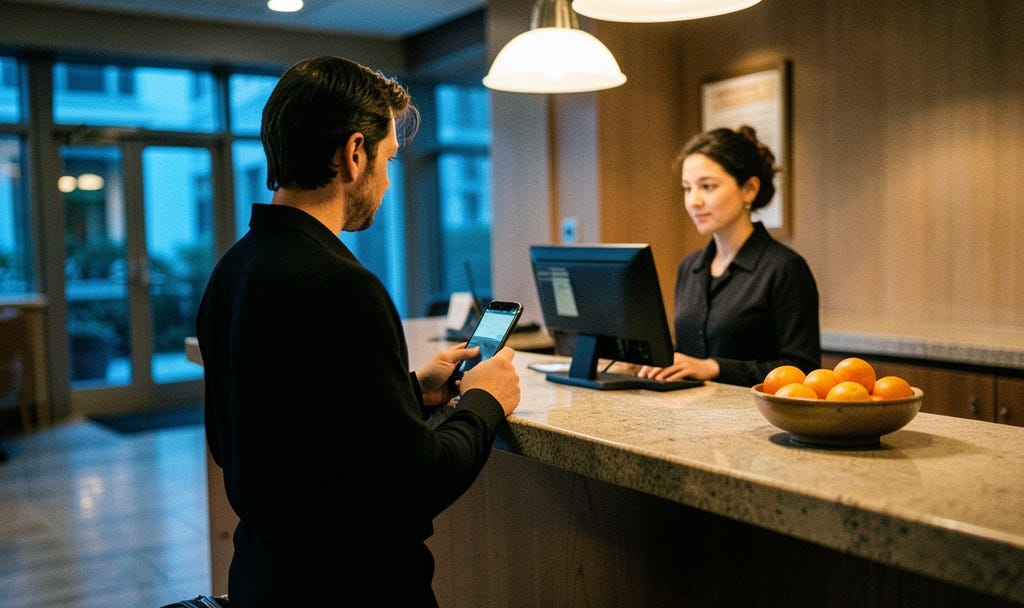
Let me turn this into questions, which I find more useful than predictions. Where does your traveler start? On the airline’s app, on a portal, on a search engine, on an assistant, or on the company’s platform? If you cannot answer, you are guessing where your policy needs to show up.
What happens to the loyalty program? A traveler who holds status with a chain has a reason to book direct, and Hilton’s 80% direct share shows how strong that reason can be. A policy that ignores it may push travelers to book in places that look cheaper and cost more in the end. I have also written about negotiating a hotel rate, and a negotiated rate is only as useful as the number of travelers who actually see it.
Does the booking reach the hotel? This is the question my old counter taught me. If an assistant or a new channel completes a purchase, who confirms that the hotel received it, and who answers when the traveler arrives at midnight and the system shows nothing? Duty of care begins at the moment the reservation exists in two places, and I would put that item in every conversation about AI agents that book travel. In October I argued, in a piece on the hotel industry and AI, that the clipboard is at risk and the craft of hospitality is safe. A reservation that never reached the system was a clipboard problem, and I would be glad to see it disappear.
Finally, who owns the relationship? The Hospitality-ON report on Google’s test said this question is still open. It matters for hotels, and it matters just as much for companies that buy hotel nights, because the owner of the relationship is the one who can fix a problem at the counter.
The reservation that was never in the system
I started with a guest waiting at a counter while a phone rang in another city, and I would like to finish there, because I think that guest is still the right test. The technology around him has changed a great deal. The reservations arrive faster, the sources multiply, the assistants begin to enter the story, and the share of AI in the hotel’s demand remains, for now, small.
I wrote once about what a bellboy learns that an algorithm does not, and the person at the counter belongs in that story. But if the day comes when a traveler’s booking starts in a conversation, passes through a platform and lands in the hotel’s system in the same second, there will still be a person who arrives at a counter, tired, with a suitcase and a phone. When something goes wrong, to whom will that person turn first, the hotel, the platform or the assistant that made the booking?
About me

I am an entrepreneur with over 20 years of experience at the intersection of tourism and technology. I am co-founder and Chief Business Officer of VOLL, the largest mobile-first corporate travel and expense management platform in Latin America, where I lead the commercial strategy behind our AI adoption.
A first-cohort graduate of The AI-Powered Organization at Stanford Graduate School of Business and a Marketing specialist from Fundação Dom Cabral, I serve on the Tourism Council of FecomércioSP and on the Executive Council of the Latin American Association of Corporate Events and Travel Management (Alagev). I write and speak about innovation, digital transformation, entrepreneurial leadership, and the future of corporate travel.
Discussion about this post