I keep hearing the same confession in expense meetings: 30 receipts in a wallet
On a Friday the 13th, the spookiest line in corporate travel is the paperwork that arrives after the trip has finally ended.


In almost every meeting where I present VOLL’s expense management to a company, the same sentence arrives sooner or later. It comes from the professionals sitting across the table, often managers and directors, sometimes with a smile and sometimes with a sigh: “I have 30, 40 receipts in my wallet, and I still haven’t requested the reimbursement.” Nobody looks embarrassed. Nobody even looks surprised. It is said the way people mention a dentist appointment they have been postponing, with the calm of a problem that everybody in the room shares.
The sentence is very common, and very frequent. The number moves from meeting to meeting, 30 receipts here, 40 there, and the sentence barely changes. It describes people who know the policy, who know what they should do, and who still carry a small paper archive of their latest trips, waiting for a quiet moment that does not seem to arrive.
Today is Friday the 13th, and I could not resist. Superstition tells us to be careful with black cats, broken mirrors and ladders. I would add one more item to the list: the stack of receipts that waits for you after a trip, quietly growing older.
The date that frightens Latin America is a Tuesday

A small confession about the calendar before the serious part. In much of the Spanish-speaking world, the unlucky day is Tuesday the 13th, and the Friday version belongs to Anglo-Saxon tradition, as La Nación explains, which lists Spain, Argentina, Chile and Mexico among the places where the Tuesday is the feared one. Here in Brazil, we talk about the Friday. I enjoy that the same number carries different fears in neighboring countries, because it is a good reminder of how much of corporate life is also cultural. The way a company handles trip expenses is one of those habits that looks universal until you compare two countries.
Two cultures, two designs

Here is a difference I notice often, and I offer it as an observation from the many conversations I have, with no claim to a scientific survey. In Latin American companies, the dominant flow is request, approval, payment and accounting. The employee asks for a sum, someone approves, the company pays, the trip happens, and afterward the employee accounts for what was spent.
In many American and European companies, the traveler tends to hold a corporate card of their own. That card usually has no blocks beyond an overall limit set by the company, a design that exists mostly for security reasons and less for compliance. The traveler knows the policy, spends, and later submits the card’s transactions for approval. Accountability sits heavily on the individual, and the tolerance for breaking the policy is small.
Neither design is better in the abstract, and I would be wary of anyone who says so. In Brazil and in much of the region, approval is part of corporate culture. People want a validation before they act, and once someone has given a go-ahead, the employee feels more comfortable spending, knowing that a previous decision backs the expense. It is a cultural logic that deserves respect, and any tool that wants to work here has to understand it, instead of importing a flow from somewhere else.
Each design protects something and postpones something. The approval-first flow protects the traveler’s confidence and the company’s sense of control, and it postpones the accounting until the trip is over. The card-first flow protects speed and trust in the individual, and it postpones the checking to the same moment. Both meet the receipt at the end, which is why I keep coming back to it. I have written before about the corporate card, and my point here is a separate one: the instrument evolves, and the paperwork follows it like a shadow.
The traditional flow, and everything that happens off the happy path

Let me describe the flow that many companies still use, because the details matter. An employee with a planned trip opens some corporate system and requests an amount. The request enters an approval process. After approval, the company takes a few days, and sometimes a few weeks, to pay into the employee’s account. With the money available, the employee travels and spends on meals and other items authorized by the policy. Back home, someone calculates the difference. If the employee spent less than they received, they must return the change. If they spent more, they account for the expenses and carry the difference from their own pocket. In both cases, the traveler must submit receipts, vouchers and invoices that justify each purchase.
That is the happy path, and I am describing it because it is the version that works. Then reality arrives. The trip is canceled. The employee asks for one more day. The itinerary changes from five days to four. Money has already left the company’s account, with no accounting evidence to explain why. The management of the change becomes tiring, delicate and sometimes sensitive, especially when an employee leaves the company or does not account for the money before the deadline.
I looked at the cost side of this in August, in a piece on why most expense reports cost more than the expense. The GBTA Foundation study behind that analysis dates from 2015, covers companies around the world and does not single out Latin America, so I will not repeat its figures today. I want to talk about the part that no study captures well: the days between the return and the report.
Where I sit
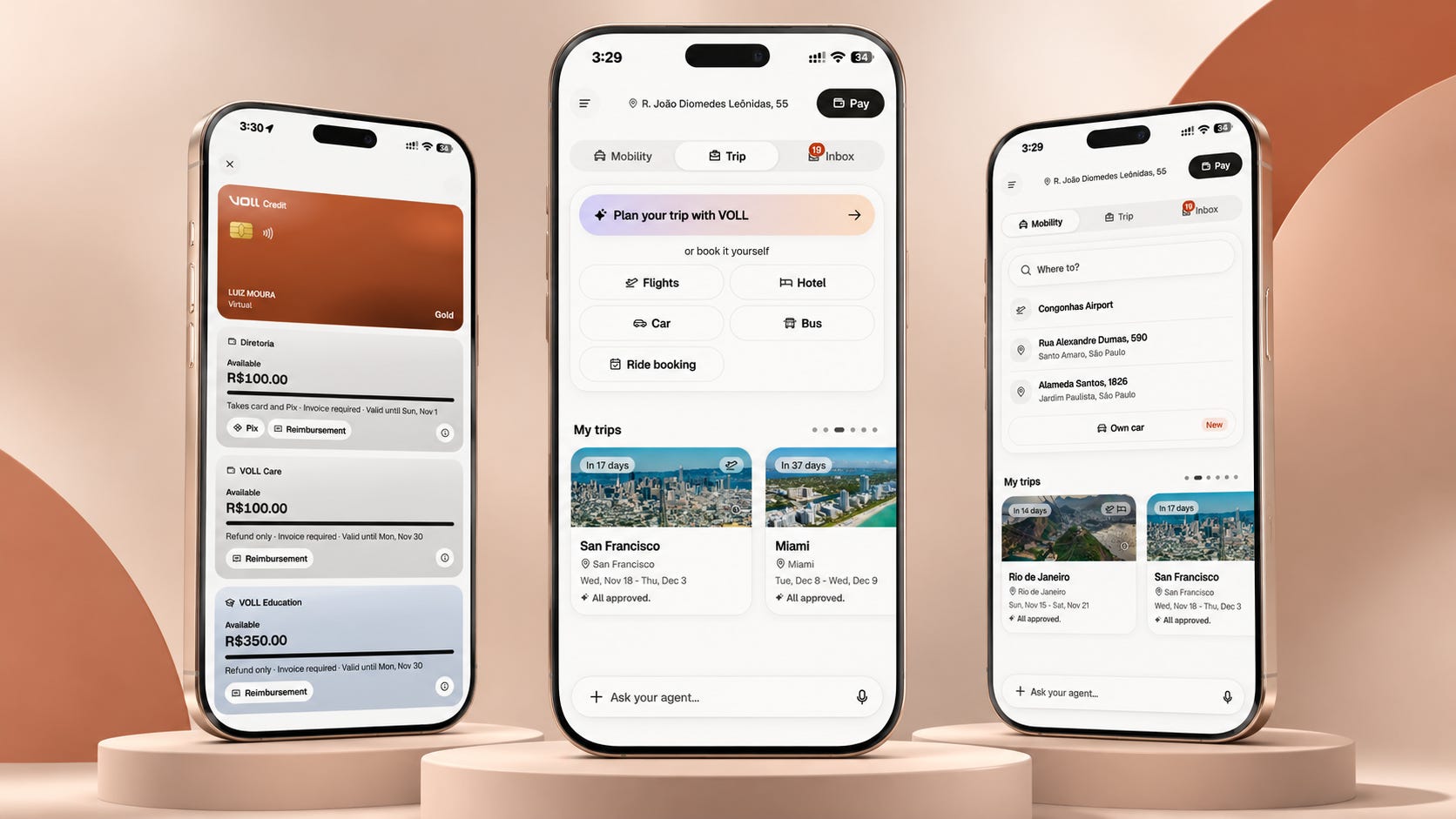
This is the point where I should tell you where I sit. The flow I am about to describe is the one my company builds, and I present it to customers every week, so please read it with that in mind. I want to describe it in the way a user would, and I will leave out any number.
At VOLL, we invert the logic. The employee does not ask for a deposit in a personal bank account to spend later. Instead, they ask for a digital balance, which lives in a virtual wallet inside the app. The amount is pre-configured by the company, as a daily multiple, a maximum value or a value per period, and it becomes available only during the days of the trip. I can request it today for a trip that happens a month from now, and the balance appears once approved and only on the days of the trip. When the period ends, we joke that it is like Cinderella: at midnight, the balance disappears.
If the company’s policy defines a daily allowance, the application counts the days in the request and multiplies by the authorized amount on its own. Canceling or changing the request before the trip is a system flow, because money never left anywhere and never arrived anywhere. It did not leave the company’s account, it did not leave VOLL’s account and it did not land in the employee’s account. During the trip, payments go through the app or through a card that the app generates, and that card has a daily block at exactly the amount the company defines, something a traditional corporate card typically does not have.
The proof of payment is captured at the moment of purchase. Suppose the daily meal allowance is a given amount and the lunch costs more than that. The traveler pays the allowance with the VOLL card and the difference with a personal card, so the policy value is never exceeded. After the payment, the app asks for a photo of the receipt, and without it the next payment is not possible. The journey is sequential and fluid, designed so that no work waits for the traveler after the return.
For the finance team, the difference is cash. In the traditional flow, money leaves the company before the trip happens, sometimes weeks before, and the company must wait to understand what that money became. In the flow I described, not a cent leaves the cash box before the expense exists, and the change that someone would chase afterward never forms. I find that the finance conversation changes tone when the question stops being “how do we chase the traveler?” and becomes “why did the money leave in the first place?” I have written about the payment problem hiding in plain sight, and I think the receipt is one of the places where that problem becomes visible to everyone. I should add that studies on the cost of manual expense reports describe manual processes in general, and they say nothing about the performance of our product.
Why a good tool still meets a full wallet

Now I return to the wallet in that sentence, because it contains the most honest part of this article. Technology has advanced a great deal, including the kind that supports this journey in a seamless way, and yet many corporate travelers still keep full wallets. I find the contradiction instructive. It tells me that the technology only solves half of the problem, because the other half is a habit.
The ideal flow is simple to say: for each trip there is an expense, and that expense should be closed immediately after the return. In practice, many corporate travelers keep a routine that is discouraging, tedious, risky and analog. The risk takes many shapes: avoidance, loss, forgetting, or simply not following the ideal flow. It is human. A traveler returns tired, with a backlog of messages and a team waiting, and the stack of paper moves to the bottom of the priority list.
What strikes me most in those meetings is who says the sentence. In my experience, it is often managers and directors, the people who approve other people’s reports, the ones who know the policy by heart. Seniority does not cure the habit. If anything, it can worsen it, because a senior traveler has more trips, less time and more reasons to postpone. I take that as a lesson for anyone designing a program: a policy that works only for people with spare time works for nobody who actually travels.
There is also a memory argument, and I label it as my own reasoning. A receipt carries very little on its own: a restaurant name, a date and a total. What gives it meaning is the context in the traveler’s head at the moment of purchase, who sat at the table and what the dinner was for. That context fades quickly. A receipt photographed the same minute keeps its meaning, and a receipt found in a wallet a month later is a small riddle that the traveler must solve from memory, usually while doing something else.
That is why I like designs that remove the choice instead of asking for willpower. A system that asks for the photo at the moment of payment moves the work to the one minute when the receipt is still in the traveler’s hand. In October I argued that the busywork of corporate travel is going to get very cheap, and a receipt is a good example of busywork that can be moved to the moment when it costs the least. My own observation is that people rarely resist the rule. They resist the delay between the rule and the moment it becomes easy to follow.
What a travel or finance manager can ask
I prefer to close the technical part with questions, since I believe they travel better than prescriptions. How many days pass, on average, between a trip’s return and the closing of its expenses? If nobody knows, the answer is probably longer than anyone would like.
Which flow does your culture reward? In a company where approval is part of the identity, a tool that asks for approval at the right moment may feel natural, while a tool that removes it entirely may feel like a loss of control. In a company that trusts the individual with a card, the opposite may be true. I wrote about a related balance between rules and reality in the IRS per diem piece, where a single assumption applied everywhere fit nowhere.
What happens off the happy path? Cancellations, an extra day, a shorter trip, an employee who leaves. Ask your team to walk through each case and to say, out loud, where the money is at each step. The answers tend to be revealing.
What happens when the person who owes the report leaves? A pending expense that belongs to a former employee is a very particular kind of problem, because nobody can ask the person who remembers what the dinner was for. If your process has no answer, the traveler’s delay has already become the company’s risk.
What does the traveler carry in the wallet? Literally. If the answer is a stack of paper, the process still depends on memory, and memory is a poor control.
The stack
I started with a sentence that I hear in almost every meeting, and I would like to leave you with a small provocation for this Friday the 13th. I wrote about the hidden cost no one puts on the expense report, and a wallet full of receipts is the most literal version of it I know. So I invite you, with the lightness that the date deserves, to open your own wallet, or to ask your travelers to open theirs, and to count.
If the number is zero, congratulations, and please tell me your secret. If it is 30 or 40, you have just met the sentence that I hear so often, and you have the best possible starting point for a conversation about how the money, the proof and the habit could travel together from the very first day of the trip.
About me

I am an entrepreneur with over 20 years of experience at the intersection of tourism and technology. I am co-founder and Chief Business Officer of VOLL, the largest mobile-first corporate travel and expense management platform in Latin America, where I lead the commercial strategy behind our AI adoption.
A first-cohort graduate of The AI-Powered Organization at Stanford Graduate School of Business and a Marketing specialist from Fundação Dom Cabral, I serve on the Tourism Council of FecomércioSP and on the Executive Council of the Latin American Association of Corporate Events and Travel Management (Alagev). I write and speak about innovation, digital transformation, entrepreneurial leadership, and the future of corporate travel.
Discussion about this post