



Where the number actually comes from
If you have sat in enough conversations about expense management, you have heard some version of this claim: an expense report costs a company around 58 dollars to process, and considerably more when it has to be corrected.
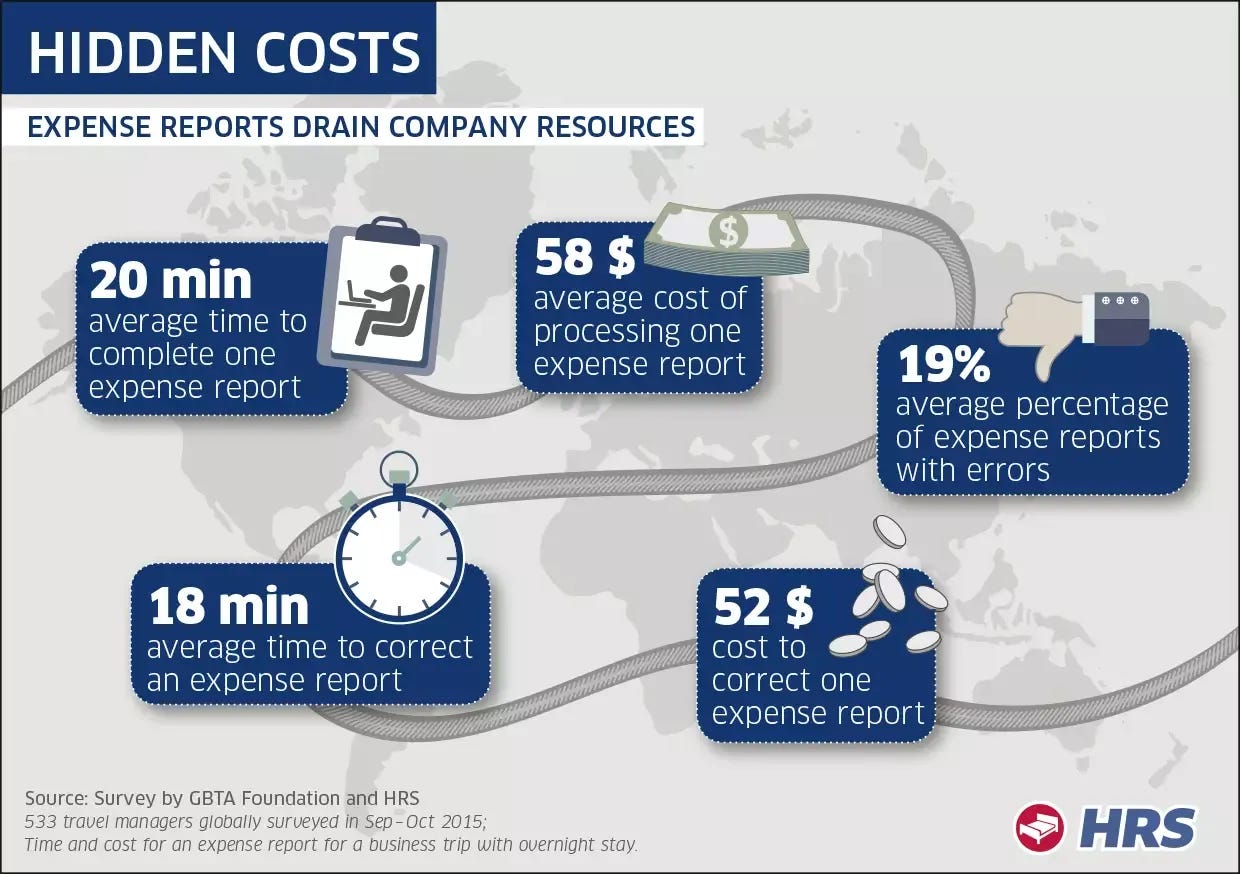
That number has a specific origin. It comes from a study the GBTA Foundation published in partnership with HRS in October 2015, based on 533 travel managers surveyed globally that September and October. The scope was narrow and clearly stated: the time and cost of processing an expense report for a business trip with an overnight hotel stay.
The findings were straightforward. Processing one expense report cost an average of 58 dollars and took 20 minutes.
Roughly one in five reports, 19 percent, contained errors or missing information, and fixing each of those added 52 dollars and 18 more minutes.
A report that goes through cleanly costs 58 dollars. A report that comes back costs 110 and takes nearly forty minutes of human time. That gap between the clean path and the corrected path is where the real money sits, and it is the part most companies never quantify.
The aggregate is the part that gets attention
The study also found that companies process an average of 51,000 expense reports a year. Applying the error rate to that volume produces the figure that made the study travel: about half a million dollars and close to 3,000 hours spent annually, per company, doing nothing except correcting mistakes in paperwork that documents decisions already made.
Three thousand hours is more than a full time position. It is a job nobody posted, nobody interviewed for, and nobody defends in a budget meeting, because the cost is spread thinly enough across enough people that it never lands on a single line.
The study also noted something counterintuitive that rarely gets quoted alongside the headline: larger companies, with more employees and higher annual spend, took less time per individual report than smaller ones. Scale helped here, which is not the usual direction for administrative process.
The eleven year problem
Here is what bothers me about how this number gets used, including by people in my own industry.
It is from 2015. The fieldwork happened in September and October of that year. Every time someone cites 58 dollars per expense report in a 2026 pitch deck, they are citing a survey conducted before most of the current expense platforms existed in their present form, before mobile receipt capture was standard, and before instant payment reshaped how business travelers actually pay for things.
I am not arguing the number is wrong. I am arguing that nobody knows, because the industry has largely stopped measuring it. A figure gets repeated until it feels like a fact, and the repetition itself becomes the reason nobody goes back to check.
That is a strange state of affairs for a cost that, by the study’s own math, runs to roughly half a million dollars a year at a single large company. It is the kind of number that should be re-measured every few years, and instead it has been quoted for a decade.
Why the Brazilian version of this problem looks different
Payment behavior in Brazil has moved faster than the process built around it, and that gap is where a lot of the friction comes from.
Looking at payment data across more than 850,000 monthly users on our platform, 64.6 percent of transactions on the corporate prepaid card are now Pix (digital instant wires). Only 35.4 percent still run on credit. Nobody ran a change management program to make that happen. Business travelers simply paid the way they already pay in their personal lives, and the corporate card followed.
The timing of that spend follows the clock of a meal rather than the clock of a workday. Close to 60 percent of everything paid happens between lunch and dinner, and the most frequent merchant category is restaurants, followed by gas stations.
Put those two facts together and you get a specific kind of reconciliation problem. Payment is instant, informal, and happens at the exact moment someone is eating or filling a tank. The documentation of that payment happens days later, at a desk, from memory. A process designed around a physical card and a printed receipt was never built for a payment method that clears in three seconds at a lunch counter.
I have written before about how Latin America adopts fast and formalizes late. Expense reporting is the clearest example I know of. The payment layer here leapfrogged. The reporting layer did not.
The cost that never appears on the invoice

Every conversation about expense software eventually becomes a conversation about license price. That is the number that goes into the procurement comparison, and it is the smallest number in the equation.
I made a version of this argument about the corporate travel ROI problem: the tools that look cheapest on a vendor invoice are frequently the most expensive once you count what it costs internally to make them work. Expense reimbursement is the purest case of that math.
A company can save forty thousand reais a year on a cheaper platform and lose several times that in reconstructed receipts, bounced approvals, and the finance analyst hours that go into chasing them.
The relevant question is not what the software costs. It is what a clean report costs versus a corrected one, and how many of each the company produces per month. Most companies cannot answer that, because nobody measures the second half.
Where AI helps (and where it does not)
The obvious move is to point AI at this problem, and it is a reasonable move. Categorizing a receipt, matching a transaction to a trip, flagging a line that falls outside policy, these are exactly the kinds of narrow, repetitive tasks where automation earns its cost quickly.
But the Amadeus “Tailored Horizons” survey found something worth pausing on. Seventy six percent of business travelers say they trust AI to assemble a travel option for them. Only forty four percent trust it to spend within the company’s budget. That thirty two point gap sits precisely on the boundary between recommending and committing, which is also the boundary this problem lives on.
There is a research reason for that caution too. Researchers from Stanford and Georgia Tech showed, in work presented at ACL in 2025, that AI agents completing web based tasks can be manipulated by content designed to fool a machine rather than a person. An agent that automatically approves reimbursements is an agent that someone eventually has an incentive to fool.
So the useful framing is narrower than full automation. AI can collapse the thirty eight minutes by removing the reconstruction work: pulling the transaction, matching it to the trip, reading the receipt, pre-filling the report before the traveler ever opens it. What it should not do, at least not without a check, is silently approve the spend at the other end. The cost being attacked here is the correction loop, not the approval itself.
Evan Konwiser of Amex GBT put it well in a Forbes interview with Jeff Fromm this month: the goal is fewer manual steps, not a new interface to learn. In expense management that means the report should mostly be finished before anyone sits down to write it.
What this changes for a travel program
The practical implication is a shift in what a travel and expense program measures.
Most programs measure spend: how much went to air, how much to hotel, how much above policy. Almost none measure process cost: how many reports required correction, how long each took, what that time is worth. A program that only measures spend will keep optimizing the visible number while the invisible one grows quietly underneath it.
The companies that get this right tend to start with an unglamorous exercise. Count the reports. Count how many came back. Multiply the corrected ones by what a corrected report actually costs. The number is usually large enough to fund the fix several times over, which is the part that surprises people. This is rarely a case of needing to justify an investment against an uncertain return. The return is already being spent, just in a form nobody put on a slide.
Thirty eight minutes does not sound like a crisis. Multiplied across a company that produces a few thousand reports a month, it is a full time job that nobody hired for and that produces nothing except documentation of decisions that were already made.
About me

I am an entrepreneur with over 20 years of experience at the intersection of tourism and technology. I am co-founder and Chief Business Officer of VOLL, the largest mobile-first corporate travel and expense management platform in Latin America, and a recognized reference in the development of the corporate travel industry.
A Marketing specialist from Fundação Dom Cabral, I serve on the Tourism Council of FecomércioSP and on the Executive Council of the Latin American Association of Corporate Events and Travel Management (Alagev). A frequent traveler and close observer of human behavior in motion, I write and speak about innovation, digital transformation, entrepreneurial leadership, and the future of corporate travel.