When budgets rise, companies write longer travel policies. Almost nobody reads them
The instinct is to tighten the rulebook. The data says the real fix is a policy people can actually follow.


When a travel budget starts climbing, the reflex inside most companies is wonderfully predictable. Someone opens the travel policy, adds a few rules, lowers a few thresholds, circulates a sterner version, and feels that order has been restored. I understand the impulse, and I think it is almost exactly backward. A new round of industry data suggests that as costs rise again, the single least effective thing a company can do is write a longer rulebook, because the one it already has is mostly going unread.
The prompt for this is a report flagging that HR teams should make travel policies workable as budgets climb, built on a survey of 204 corporate travel buyers from the Business Travel Show America. The headline pressure is real: 45 percent expect their organization’s travel spending to rise in 2027, and 30 percent say costs are already significantly above what they planned. I run a company on the corporate side of this industry, so I spend a lot of time inside this exact tension, and I want to make the case that the answer to rising cost is not a stricter policy but a usable one.
The rulebook nobody reads

Start with the uncomfortable shape of the typical policy. In a separate GBTA study of corporate travel managers, the documents have quietly become enormous. More than half of travel policies now run beyond ten pages, and roughly a quarter exceed twenty, which is less a guideline than a short legal treatise. Policies have been getting stricter, not looser, with far more companies tightening than relaxing over the past three years.
Here is the punchline, and it is a quiet indictment of the whole approach. When those same managers were asked why employees break the rules, the most common answer, cited by about a third, was simply that people had not read the policy or were not familiar with it. The breach was rarely an act of rebellion, it was an act of not knowing, which is a very different problem and one that more rules cannot solve. The document grew precisely in the years when fewer people were absorbing it, which tells you the length and the compliance are moving in opposite directions.
Tellingly, nearly two thirds of the managers said they would welcome short AI-generated video explainers of the key points, which is a very polite way of admitting that nobody is going to read twenty pages. A rule that lives on page eighteen of a document no one opens is not a control. It is a decoration.
The vague rules are the ones that get broken
If length is half the problem, vagueness is the other half, and the data points straight at it. In that same policy study, 46 percent of companies tell employees to book a hotel at a “reasonably priced” rate, a phrase the report explicitly links to compliance trouble, and it is easy to see why. Reasonable to whom? The traveler landing at midnight and the finance analyst reviewing the expense three weeks later will define that word very differently, and the gap between their definitions is where the argument, and the overspend, lives.
Compare that to where the real leakage shows up. The biggest compliance problem managers named was booking outside the required channels, cited by 35 percent, with out-of-policy hotel stays close behind. Those two facts belong together. When the rule is vague and the approved tool is clunky, the traveler does the human thing and books wherever is easiest, and the company loses both the negotiated rate and the visibility. I have written before about how this kind of spend quietly disappears from a program’s view, and a fuzzy policy is one of its main causes. You cannot enforce a rule that was never precise enough to break cleanly in the first place.
Workable beats strict
So what actually works? The most useful line in the report comes from Chloe Carver of Acquis Consulting, quoted in the same coverage, and it deserves to be printed on the wall of every travel program. “A policy that isn’t enforceable or has never actually been enforced is hard to then start enforcing.” That one sentence quietly dismantles the tighten-the-rules reflex, because a rule you will not or cannot enforce is worse than no rule, it just trains everyone to treat the whole document as optional.
Her prescription is refreshingly unglamorous. Design the policy with the people who live inside it, which means HR, finance, accounts payable, and the frequent travelers themselves, not just a procurement team working alone. Explain the reasoning behind each rule, because a traveler who understands why a rule exists is far more likely to follow it than one handed a command. Align the booking and expense tools so they point the same way. And, crucially, confirm that the options the policy tells people to use are genuinely available when they go to book.
A policy that instructs an employee to use a channel that does not actually show the right fare is not a policy, it is a trap with the traveler’s name on it.
Notice what every one of those moves has in common. None of them is a new restriction. They are all about making the existing rules legible, reasonable, and reachable, which is the opposite of the instinct to add clauses. Co-design, in particular, does quiet magic that a procurement team cannot replicate alone, because the frequent traveler knows exactly where the policy collides with reality, the late arrival with no approved hotel nearby, the client dinner that blows a per diem written for a different city, the approval that takes so long the fare is gone by the time it clears.
Those collisions are invisible from a conference room and obvious from seat 9C. A policy written with that knowledge in the room starts out workable. One written without it starts out as fiction that everyone politely agrees to ignore.
The tools have to make the right choice the easy choice
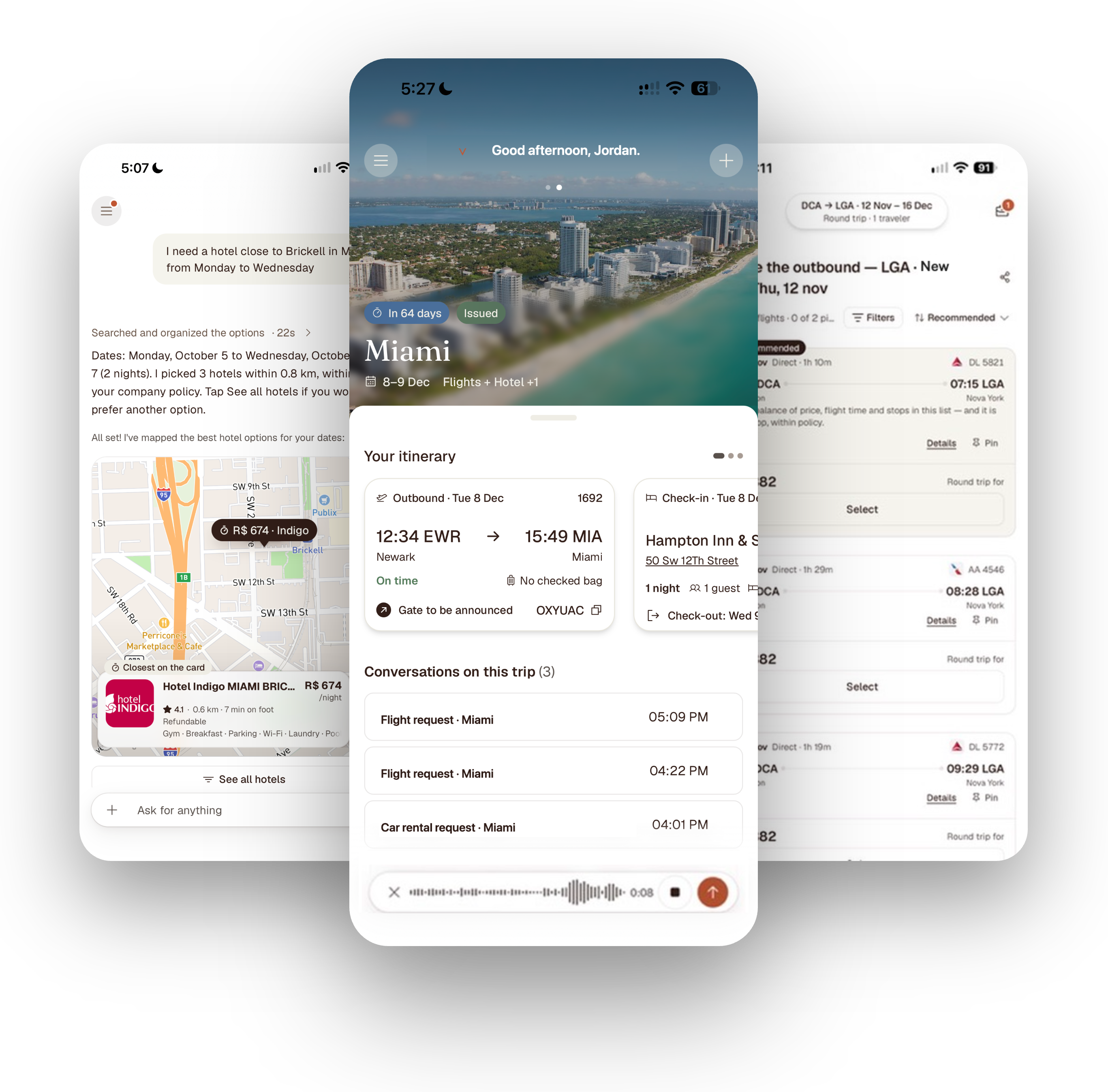
This is where my own work sits, so I will declare the interest plainly rather than pretend to neutrality. The reason policies fail in practice is almost always a gap between what the document says and what the systems make easy, and closing that gap is largely a technology and design problem.
The goal is simple to state and hard to execute: make the in-policy choice the path of least resistance.
When the compliant flight is the one the tool surfaces first, when the negotiated hotel rate actually appears at the moment of booking, when the expense side recognizes what the booking side already approved, compliance stops being a matter of willpower and becomes the default.
There is a pleasant side effect, too. When the system quietly handles the rules, the policy document itself can finally go on a diet, shrinking from a twenty-page treatise to a short, readable statement of principle, because it no longer has to anticipate every edge case in prose. The software holds the detail, and the human reads the intent. That is a very different philosophy from enforcement by punishment. It treats the traveler as a busy person who will follow the easy, sensible path if you build one, rather than as a suspect to be policed.
I have argued that the traveler was never really asking for another app to fight with, and the same is true of policy. They are asking for the right thing to also be the simple thing. Get that alignment right and the twenty-page document can shrink to something a human being might actually read, because the system, not the PDF, is carrying most of the rules.
A policy is an experience, not only a budget line
The quietly radical idea in the Onrec report is that travel policy belongs partly to HR, not only to finance, because it shapes an employee’s time, working conditions, and experience, and not just the company’s costs. That reframing matters. A policy is one of the most frequent, tangible ways a company tells its people how much it values their time on the road, and a hostile, confusing one sends a message no amount of wellbeing branding can undo.
There is also a practical mechanism hiding in this reframing, and it costs nothing. The people who know exactly where a policy fails are the ones who bump into its edges every week, so the cheapest research a program will ever run is simply asking its frequent travelers what the policy makes needlessly hard.
That feedback loop turns a static document into a living one, surfacing the avoidable friction, the approval that always stalls, the city where the rate cap never works, before it hardens into routine non-compliance. Most programs never ask, and then express surprise when the rules are quietly ignored.
This is also where the gaps get serious. The same policy research found that very few programs give clear guidance for the specific needs of different travelers, with only around one in five offering clear direction for groups such as women travelers, whose safety considerations on the road are real and well documented. I have written about how experience is the thing travelers quietly refuse to give up, and policy is where that experience is either protected or quietly eroded. A workable policy is, in the end, a respectful one. It assumes people want to do the right thing and removes the friction that stops them, which is a far better use of a rising budget than another page of restrictions.
What this means for Latin America

I will close, as I usually do, from my own region, because the timing here is specific. Business travel spending across Latin America is forecast to keep climbing, and with it the same temptation to respond to cost with control. The opportunity, as the regional programs mature, is to skip the long and painful chapter that older markets are now trying to undo, the one where policies grew into unreadable documents that nobody followed. We can build workable from the start.
That fits the broader case I keep making, that this is an unusually good moment to be building travel programs in this region, precisely because much of the structure is still being written. A company designing its travel policy today, with the booking and expense systems aligned and the frequent travelers in the room, can land somewhere the giants are struggling to reach, which is a program people actually comply with because it was built to be followed. Rising budgets will test every program’s discipline. The ones that respond with a usable policy rather than a longer one will spend the next few years with their money and their people’s goodwill intact, and the ones that just add rules will keep wondering why page eighteen never seems to work.
The shortest rule that works
So when the budget climbs and the instinct says tighten, it is worth remembering what the data actually shows. The policy is probably already too long, mostly unread, vague in the places that matter, and undermined by tools that make the compliant choice the hard one. None of that is fixed by another clause.
A rule only works if a reasonable person can find it, understand it, and follow it on a bad day at an airport gate.
Everything else is paperwork. It is the same lesson I keep drawing about this whole business, that the value hides in the structure underneath rather than in the document on top, and a travel policy is simply that lesson written down and, too often, written badly. The companies that internalize that, as costs rise, will discover the same quiet truth every good travel program eventually learns: the most powerful policy is not the strictest one, it is the one people can actually live by.
About me

I am an entrepreneur with over 20 years of experience at the intersection of tourism and technology. I am co-founder and Chief Business Officer of VOLL, the largest mobile-first corporate travel and expense management platform in Latin America, where I lead the commercial strategy behind our AI adoption.
A first-cohort graduate of The AI-Powered Organization at Stanford Graduate School of Business and a Marketing specialist from Fundação Dom Cabral, I serve on the Tourism Council of FecomércioSP and on the Executive Council of the Latin American Association of Corporate Events and Travel Management (Alagev). I write and speak about innovation, digital transformation, entrepreneurial leadership, and the future of corporate travel.
Discussion about this post