



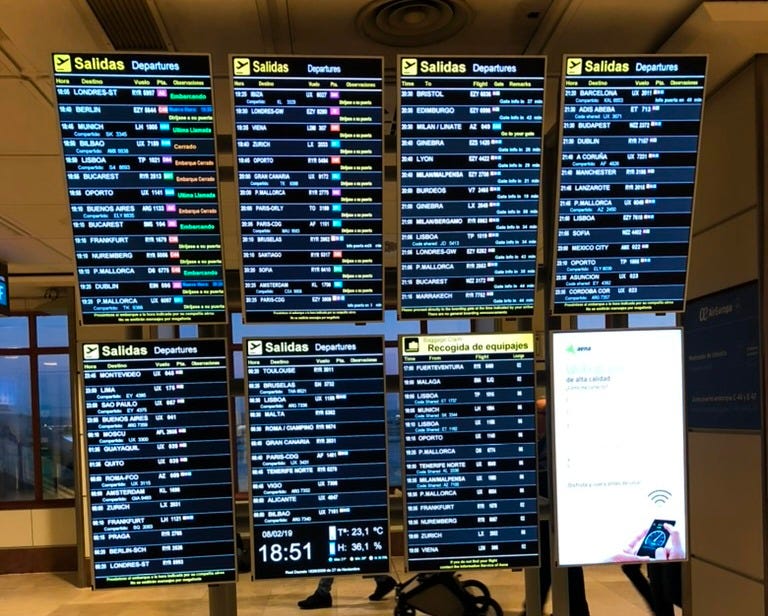
It was a Thursday night. I had just landed at Madrid-Barajas after a transatlantic flight from São Paulo, and the immensity of the airport was not going to be my only discovery of the trip. The gate had been updated on the screen, which now told me it would take about twelve minutes on foot to reach it. This airport really is enormous, I thought.
When I arrived at the gate, a small detail hit me. I was about to take a domestic flight, entirely within Spain, on an Irish airline. It was going to be my first time flying Ryanair. As an aviation nerd, you can’t imagine how happy I was.
That short leg from Madrid to Palma de Mallorca, operated by a carrier that did not exist in Spain and had never registered a plane there, was a small everyday miracle. It was also, in a way, a piece of policy that had been written years before I was born and that I was living without thinking about. Somewhere in the mid-1990s, European regulators had decided that the sky above their continent would not belong to any one country. It would belong to the market. That decision remade the industry.
Almost thirty years later, and half a world away, South America has just made the same decision, at least on paper. The scale is different, the geography is unforgiving, and the timeline is going to be measured in years, not months. But the direction of travel is unmistakable, and it deserves a serious reading.
What actually happened
On July 14, 2026, in Asunción, Paraguay, four countries signed a memorandum of understanding with an ambitious name and a modest immediate effect. The document is called the Acordo para Alas, the Agreement for the Liberalization of the South American Skies. Brazil, Argentina, Chile and Paraguay are the founding signatories. Uruguay and Bolivia are expected to join once their internal administrative procedures are complete.
The memorandum does not, by itself, change market access. What it does is set a twelve-month deadline for governments to build a common regulatory environment and progressively reduce the barriers that today keep airlines from operating freely across the region.
In practice, an Argentine, Chilean or Paraguayan airline cannot, today, sell a ticket between two Brazilian cities as part of an international route. And a Brazilian carrier cannot do the same in the other direction. That is the rule the agreement intends to dismantle, in stages. The first stage targets what the industry calls the eighth freedom of the air, cabotage attached to an international route: a foreign carrier picking up passengers in São Paulo on its way to Manaus, provided the flight originated abroad. Later stages, more distant and more politically demanding, aim at unrestricted operation of any carrier in any market within the group.
This is the same architecture Europe used in the 1990s. It is not a copy, and it cannot be one, but the intellectual lineage is clear.
The size of the prize
The four founding countries mobilized nearly 190 million passengers in 2025. Brazil accounts for the overwhelming majority of that total, at around 130 million, followed by Argentina at 30 million, Chile at 28 million and Paraguay at 1.3 million. Aviation Week, analyzing OAG scheduling data, reported that airlines are scheduled to offer about 118.6 million departure seats from and within the four signatory countries during the northern summer 2026 season, representing roughly 64 percent of all departure seats in South America.
The largest country pair among the four is Brazil-Argentina, with about 3.68 million scheduled seats. Brazil-Chile is next, with 2.18 million. Argentina-Chile follows with nearly 1.57 million. Links involving Paraguay remain modest but not trivial: Argentina-Paraguay and Brazil-Paraguay together account for more than 530,000 scheduled seats.
Brazil is the anchor. According to OAG, Brazil remains the largest single-country market in Latin America with 12.1 million international seats and 10.7 million domestic seats as of mid-2025, and it holds nearly 48 percent of the entire South American aviation market by market size, per Mordor Intelligence. Whatever the region does about integration, it does with Brazil at the center.
The regional passenger growth data reinforces the timing. The Airports Council International Latin America and Caribbean reported that passenger traffic in the region between January and September 2025 grew 5.43 percent over the same period of 2024, surpassing the initial annual forecast of 4.1 percent. Argentina led the expansion with 13.5 percent growth, followed by Brazil with 8.87 percent and Peru with 7.1 percent. The market is not opening at a moment of stagnation. It is opening in the middle of a demand cycle that has been outperforming forecasts.
What Europe teaches, and what it does not
If you want to know what a liberalized regional aviation market does over time, the European record is the most complete natural experiment available.
The academic consensus is unambiguous on the direction of the effect. A 2018 study analyzing traffic flows over fourteen years between EU countries and 27 external partners found that liberalization agreements led to fare reductions of between 6 and 23 percent, which in turn spurred a 27 percent increase in demand. A separate study of transatlantic markets found that liberal bilateral agreements were associated with fare reductions of approximately 40 percent and a 55 percent increase in accessibility, measured by non-stop service availability.
The OECD’s own historical review of European air transport liberalization documents that the real yield for European airlines fell from roughly 21 cents per passenger-kilometer in 1990 to about 9 cents in 2013. That is not a marginal shift. That is a structural repricing of what it costs to fly across a continent.
But the European story contains a warning that the celebratory version usually leaves out. The benefits did not arrive immediately, and they did not arrive uniformly.
The First Package of European liberalization was adopted in December 1987. The Third Package, the one that effectively completed the single aviation market, only took effect in April 1997. That is ten years from the beginning of the political process to the moment the market actually functioned as a single space. In the years between, average route frequencies barely moved. It was only in the second half of the 1990s that low-cost carriers, Ryanair chief among them, began to reshape the map. Ryanair itself was founded in 1984 but only relaunched as “Europe’s first low fares airline” at the turn of the 1990s, and only became a dominant force in the 2000s.
The lesson is not that liberalization does not work. It clearly does. The lesson is that liberalization is a policy input, and the market takes years to translate it into consumer outcomes. Anyone promising South American passengers cheaper tickets in 2027 is misreading the historical clock.
Why the European model cannot be directly copied
Three structural differences make a straight transplant of the European framework impossible.
The first is geography. Europe is compact. Its major hubs are, at most, three hours apart by air, and often less. Most intra-European routes are short-haul flights that suit the economics of narrow-body low-cost operation. South America is continental in scale. The distance from Santiago to Recife is greater than the distance from Lisbon to Moscow. Between the population centers of the region lie stretches of Amazon, Patagonia and Andes that no low-cost carrier in the world has an economic model to serve. The routes where liberalization will most likely produce price competition are a specific subset: the busiest corridors between the largest metros. The rest of the map will change more slowly, if at all.
The second is regulatory. The European Union spent decades building the institutional infrastructure that made the single aviation market possible. A single certification authority, harmonized labor law, uniform consumer protection rules, a common approach to slot allocation and airport charges. South America has four countries signing a memorandum, each with its own regulator, its own labor regime, and its own consumer protection framework. Building a common regulatory environment in twelve months, as the memorandum aspires to, is technically possible but historically unprecedented at this speed. Realistically, the negotiation will run longer, and the harmonization will happen in layers.
The third is asymmetry. Brazil is not just the largest market. It is larger than the three other signatories combined, by a wide margin. A liberalization framework designed as if the four countries were peers will not survive contact with the market. Brazilian airlines have a domestic network, a fidelity program base, a slot position at key airports, and an operational maturity that their neighbors, on average, do not match. Foreign carriers will look at the Brazilian domestic market with interest. Brazilian carriers will look at the neighboring markets and see them as marginal opportunities. That asymmetry will shape everything about how the market opens.
What actually changes for the passenger, and when
The honest answer, for the traveler, is that nothing changes yet. What was signed is a memorandum that gives governments twelve months to define the rules. Only after that does implementation begin, and only in stages. Add the time it takes for carriers to adapt operations, marketing, distribution and fleet, and you are looking at meaningful passenger-facing changes in two to three years, at the earliest. That is if political will holds, which is a large “if” in a region where administrations change and coalitions shift.
When change does arrive, it will not arrive uniformly. The dense, profitable corridors will feel it first. São Paulo-Buenos Aires, Santiago-São Paulo, Buenos Aires-Santiago, these are the routes where a new entrant can put a plane and fill it, where competition can pressure fares, where the passenger will notice a difference. Regional and secondary routes, the ones that serve the underserved cities I have written about elsewhere in this newsletter, will be harder to change. Their economics do not shift because the paperwork does.
The other place passengers may feel change earlier is on international connections. If a Chilean carrier can pick up passengers in Manaus on its way to Buenos Aires, and vice versa, the effective network available to a traveler in a secondary city expands. The gain is not necessarily in price, at least not at first. It is in options.
What it means for the airlines
The prevailing narrative in some coverage frames the agreement as a challenge to the dominance of Brazil’s three major carriers. That framing captures something real, but it flattens the analysis.
Brazilian airlines carry structural advantages that a memorandum does not erase. They have the domestic network that produces feed for international routes. They have loyalty programs with millions of members and years of accumulated switching cost. They have slot positions at congested airports that a new entrant cannot replicate on demand. They have operational familiarity with a complex regulatory and infrastructural environment that outsiders would have to learn.
What the agreement does is remove one of the barriers that has insulated them from competition on certain routes. It does not remove the others.
The scenario I find most likely, and most consistent with the European precedent, is not substitution but pressure. New entrants will target the profitable corridors, most likely with a narrow-body low-cost model or as extensions of existing international networks. Incumbent Brazilian carriers will feel yield pressure on those specific routes, and will need to respond, most likely with a mix of price adjustments in threatened segments, differentiation in premium and loyalty products, and operational improvements aimed at reducing cost per seat. The airlines that emerge stronger from this process, in Brazil and elsewhere, will be the ones that treat this as a modernization mandate and not as a defensive posture. The ones that spend the next three years lobbying against implementation will find themselves outflanked when it arrives anyway.
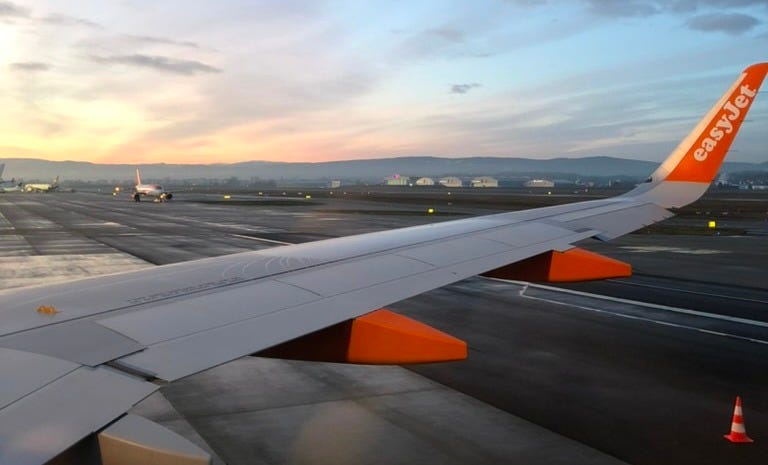
There is also an interesting question about who benefits most. In Europe, the biggest winners of liberalization were not the legacy carriers, most of whom struggled and consolidated. The biggest winners were the low-cost carriers that took advantage of the new rules to build networks unthinkable under the old regime. Ryanair, EasyJet and their peers reshaped an entire industry. Whether South America produces analogous winners is uncertain. The region has never sustained a large low-cost carrier for long. The economics of long-distance routes and volatile currencies make the model harder. But if any policy environment could give a well-capitalized new entrant the space to try again, it would be this one.
What the rulemaking has to solve
Twelve months is a short time to build a common regulatory environment across four sovereign jurisdictions. The technical agenda is substantial, and it clusters into three blocks.
The first is labor and taxation. If a foreign carrier can operate in Brazil while paying labor costs from its country of origin, and Brazilian carriers are bound by Brazilian labor law, the competition is not on equal terms. Some form of floor, whether through minimum labor standards or through obligations tied to operating certificates, will be necessary. The same applies to taxation and to airport charges.
The second is safety and certification. Each country today has its own aviation authority. For a genuine single market to function, mutual recognition of certifications, on aircraft, on operators, on personnel, has to become the default. This exists in part today through bilateral agreements, but a common framework across the four countries, with a shared floor of safety oversight, will be the technical backbone of everything else.
The third, and most important for the traveler, is consumer protection. Rights in the event of cancellation, delay, denied boarding and lost baggage vary meaningfully across countries. A passenger flying a Paraguayan carrier between two Brazilian cities needs to know, clearly, which set of rules applies. Absent harmonization, or at least mutual recognition, the passenger becomes the shock absorber for regulatory ambiguity.
Solve these three blocks, and the framework has a chance to work. Skip any of them, and the market that emerges will be a lesser version of what the memorandum promises.
What I will be watching
The agreement is a beginning, and I plan to write about it again as it moves.
Three things will tell us whether the framework has a real future.
The first is the composition of the working group that turns the memorandum into rules over the next twelve months. If it is dominated by transport ministries with technical mandates and clear political backing, the timeline is credible. If it becomes a proxy for other trade disputes across the four countries, delay is likely.
The second is which carriers move first. The most telling signal will be the first serious announcement of a foreign carrier committing to route rights within Brazil under the new framework. Announcements will come. Actual capacity commitments, with aircraft assigned and slots secured, are the real leading indicator.
The third is what the incumbent Brazilian carriers do in the interim. Do they invest in modernization, differentiation and cost improvements now, or do they wait? The ones that wait tend, in the historical record, to lose the most when the environment changes around them.
Coming back to Madrid-Palma
I remember, walking down the jetbridge to that Ryanair flight in 2018, thinking that what was ordinary for me had been unimaginable a generation earlier. A Spanish domestic flight operated by an Irish airline is not a technical miracle. It is a policy outcome, from a decision made by regulators who chose to treat the sky as a shared resource rather than a national one.
South America has just made the first serious attempt to make its own version of that decision. The distances are longer, the institutions younger, the asymmetries larger, and the politics harder. The framework may take longer to mature than its authors project. Some passengers reading this will be old enough, when they finally board an Argentine flight from São Paulo to Manaus without noticing, to remember when it seemed impossible.
But that is the direction this is moving. And on Thursday, July 14, 2026, in a room in Asunción, four countries signed a document that said, in effect, that the sky above them would not belong to any one of them anymore.
That is worth writing about, even before it is worth booking a ticket for.
About me

I am an entrepreneur with over 20 years of experience at the intersection of tourism and technology. I am co-founder and Chief Business Officer of VOLL, the largest mobile-first corporate travel and expense management platform in Latin America, and a recognized reference in the development of the corporate travel industry.
A Marketing specialist from Fundação Dom Cabral, I serve on the Tourism Council of FecomércioSP and on the Executive Council of the Latin American Association of Corporate Events and Travel Management (Alagev). A frequent traveler and close observer of human behavior in motion, I write and speak about innovation, digital transformation, entrepreneurial leadership, and the future of corporate travel.