


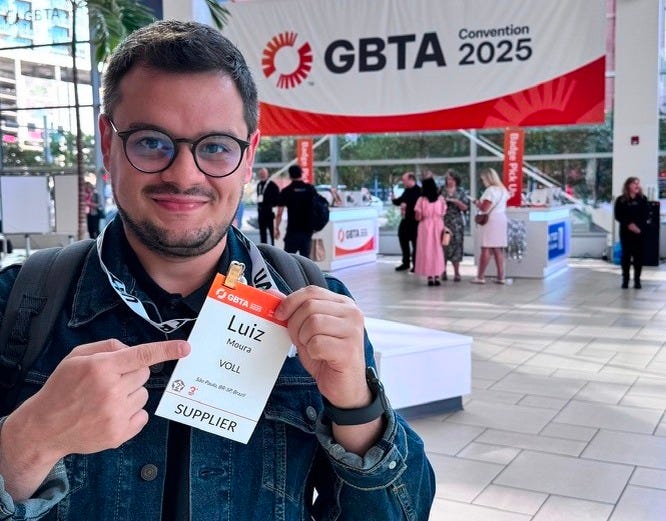
My suitcase is open on the bed, and I am doing the thing I always do before this trip: deciding which blazer survives a week of McCormick Place air conditioning and which one does not.
This will be my fourth GBTA Convention in person. Dallas, then Atlanta, then Denver, and now Chicago. Each one has its own texture in my memory: Dallas for how overwhelming the scale felt the first time, Atlanta for the conversations that turned into partnerships, Denver for the year the forecast session filled a room that should have held half as many people. I do not remember the keynotes as well as I remember the hallways. That is where this industry actually happens.
This year I am packing a little differently. A few months ago, GBTA selected me as one of ten professionals worldwide put forward as a candidate for a seat on its Global Board of Directors, the governing body of the largest association in this industry. I do not hold that seat, and I want to be precise about the difference, because it matters: being one of ten people an organization operating at that scale chooses to put forward is not the same as sitting on the board, and I will not blur the two. But the recognition traveled further than I could have taken it myself, through GBTA’s own press releases, hotsites, and social channels, carrying my name and my story to a global industry audience I had not reached on my own before. As far as I know, I am the only Brazilian and the only TMC founder on that list. That changes how I read an agenda before I have even set foot in the building, and it changes what I feel obligated to say once I do.
So before I board, I want to do something I have not done before a convention: read the entire program in advance, cover to cover, more than 120 education sessions across four days, and tell you what it already says about the state of this industry, before a single panel has actually happened.
The thesis, stated plainly
Here it is, before the scenery. This year’s agenda is not organized around a single big idea the way some past years have been. It is organized around an argument that has not been settled, and the sessions are the two sides of it talking past each other in the same building.
One side of the argument says that artificial intelligence is already changing how travel gets bought, booked, and governed, and that the industry’s job now is building the guardrails fast enough to keep up. The other side says that most of what gets called AI in this industry is still marketing dressed up as innovation, and that the real work is proving value the old-fashioned way, with data the business actually trusts. Both sides have multiple sessions. Neither side has the room to itself. That tension, not any single headline, is what a careful read of the program actually reveals, and it shows up again and again across sustainability, payments, hospitality, and talent, not just in the sessions that mention AI in the title.
Three days built like an argument, not a schedule
The shape of the week matters as much as its content, so it is worth walking through before getting into any single session.
Monday opens with orientation and the expo floor, and closes with the Main Stage: GBTA’s own CEO Suzanne Neufang presenting the association’s latest read on where global spend and volume are heading, with a cameo conversation alongside United Airlines CEO Scott Kirby. The day ends on a keynote about resilience through rejection, which is an unusual choice to open a business travel convention with, and I suspect a deliberate one. You do not open with a talk about handling rejection unless you expect the week ahead to involve some.
Tuesday is the heaviest day by a wide margin, with dozens of concurrent education sessions packed into two morning blocks before a Main Stage built around a CEO panel, Southwest’s Bob Jordan and Cvent’s Reggie Aggarwal, and a keynote from Harvard Business School’s Frances Frei and her longtime collaborator Anne Morriss on moving fast without breaking what matters. Wednesday closes the week with a mix of practical workshops in the morning and a Main Stage that ends, notably, not with an industry figure but with chef and humanitarian José Andrés, in a fireside conversation about leadership under pressure.
Read end to end, the week moves from forecast to argument to reflection. That is not a normal shape for an industry conference, and I think it is the right one for where this industry actually is.
The agentic AI argument nobody has settled yet
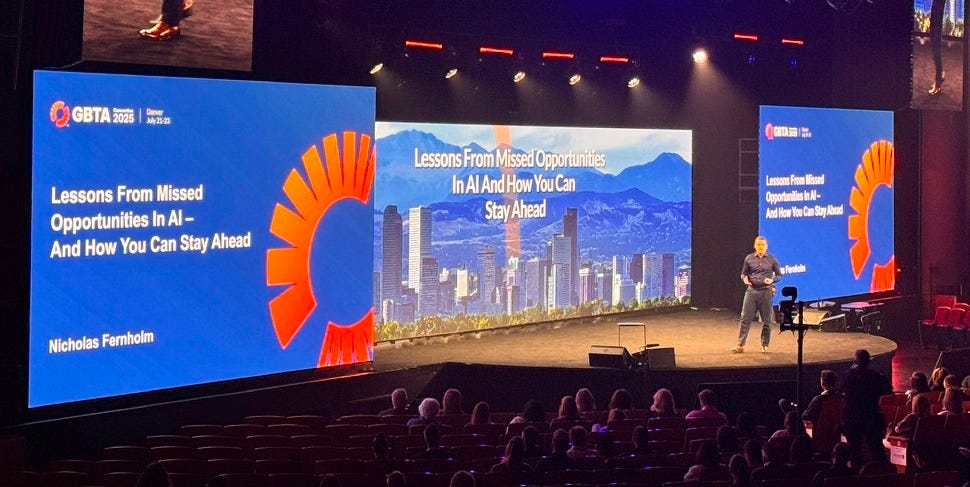
If there is one storyline that runs through more of the agenda than any other, it is the fight over what agentic AI is actually allowed to do inside a managed travel program, and who is accountable when it gets something wrong.
One session asks the question as plainly as I have seen it asked anywhere: who decides, when an AI agent moves from making recommendations to taking autonomous action in shopping and booking. The framework on offer there is built around three control layers working together: traveler memory, corporate memory, and a dynamic policy engine, which is a more precise way of describing governance than most of what I have read on this topic elsewhere. Another session, built around a live evaluation exercise the presenters are calling an AI Bingo, exists specifically to help buyers tell real generative and agentic capability apart from vendors repeating the words because everyone else is. A third argues, provocatively, that NDC is effectively dead and that AI is what actually reshapes airline retailing going forward, which is the kind of claim I expect to generate more disagreement in the room than agreement. A fourth frames AI as the new front door for travel decisions entirely, bypassing the corporate booking channel most programs spent a decade building.
None of these sessions assumes AI adoption is a foregone conclusion. All of them assume something harder and more useful: that the technology is already inside the workflow, and the open question is not whether to use it but how much authority to hand it, and how to prove that authority was earned rather than assumed.
The value question travel has been avoiding

Running in parallel, and sometimes literally in the next room, is a second argument that I recognize immediately because I have been making a version of it myself. It is about whether travel programs can actually demonstrate what they are worth, and what happens when they cannot.
One session states the stakes with unusual honesty: that AI will likely shrink the raw demand for routine meetings, which makes proving the value of the trips that remain, especially the ones built on trust rather than transaction, no longer optional. Another is framed explicitly around helping travel and finance leaders speak the same language, translating program metrics into the risk, opportunity, and timing signals a CFO actually cares about, rather than the budget-variance reporting that travel teams have relied on for years. A third names the problem almost too directly for comfort, built around the idea that a travel function too often gets treated as the department whose only answer is no, and needs a toolkit to reposition itself as a strategic enabler instead. A fourth is a full research session where GBTA’s own team walks through what its 2026 portfolio actually found, cross-referenced against a separate index maintained by Cornerstone, which tells me the association itself feels the pressure to answer this question with more rigor than a single slide can carry.
I have written at length about why this problem is structural rather than analytical: the travel function holds the cost data completely and the outcome data almost never, and asking it to prove return under those conditions produces a cost report that then gets mistaken for evidence the return does not exist. Reading this year’s session list, that argument is clearly not mine alone anymore. It has become one of the two organizing arguments of the entire convention.
Money follows attention, and this year it follows reconciliation
A quieter version of the value argument is happening inside the sessions about payments, and it deserves its own paragraph because the framing is unusually blunt.
One session describes payment reconciliation as death by a thousand cuts: not one catastrophic failure but an accumulation of unclear policy, messy bookings, missing or AI-generated receipts, and timing gaps between systems, none of which shows up as a single line item anyone gets fired over, all of which adds up to a program nobody fully trusts. Another approaches the same territory from the opposite direction, asking attendees to play fraud detective across a set of real scenarios, distinguishing what is fraud, what is simple error, and what is risk the company has quietly accepted without ever deciding to. A third, co-developed with American Express, argues that AI only creates value in this part of the business when it sits on top of genuinely connected data across travel, cards, and expense systems, which is the same data-readiness argument I keep making about AI everywhere else in this industry, just relocated to the reconciliation team’s desk instead of the booking tool.
None of this is glamorous, and all of it is where the actual savings a CFO can verify tend to hide. A travel program can claim any number it wants about bookings and compliance. A reconciliation process that closes cleanly, on time, without a forensic investigation, is one of the few claims in this entire industry that is genuinely hard to fake.
The sustainability sessions are quieter than they used to be
I have attended enough of these conventions now to notice when a topic’s tone shifts, and sustainability has shifted this year, from advocacy toward arithmetic.
One session opens with a statistic sharp enough to reorganize an entire program around it: just thirty percent of travelers generate seventy percent of a program’s emissions, and the top five percent alone account for a third of both its cost and its carbon footprint. That is not a call to reduce travel broadly. It is an argument for finding a small, identifiable group of travelers and building a different set of nudges around them specifically, using the same data and AI tooling this convention spends the rest of its time arguing about. Another session takes the debate head on, staging sustainability and cost as a genuine either-or in front of the audience, then testing whether that trade-off actually holds up against real program data or whether it was always a false choice dressed up as a hard constraint. A third walks through sustainable aviation fuel with almost none of the abstraction the topic usually gets: how book-and-claim programs actually work, how emissions reductions get calculated and reported, and what a travel manager should ask a supplier before believing a claim about it.
The version of sustainability on this year’s program is not the version built for a corporate values page. It is the version built for someone who has to defend a number to their own CFO by Friday, which is a better sign for the topic’s staying power than any amount of enthusiasm would be.
Hospitality’s own value argument
If travel management has a value problem with finance, hotel programs have a version of the same problem with their own negotiated rates, and this year’s agenda takes it on directly.
One session opens with a number I have not seen stated this plainly before: on average, eight and a half out of every ten hotel bookings are not landing on the rate a company actually negotiated. That is not a rounding error. That is a program paying, most of the time, for a rate it fought to secure and rarely receives. Another session reframes the entire buyer-supplier relationship around that same gap, arguing that the transactional model built around annual RFPs and negotiated rates is reaching its structural limit, and that the programs getting real value now are the ones treating hotel partnerships as long-term collaboration rather than an annual price negotiation repeated on a calendar. A third walks through GBTA’s own newly released global hotel RFP standards, built to bring some shared structure to a sourcing process that has historically varied wildly by market and by buyer.
Read together with the fragmentation session, the hospitality track this year is making almost exactly the same argument the AI governance sessions are making about booking data: visibility is not a feature, it is the entire product, and a program that cannot see what its own negotiated rate actually delivers is not fundamentally different from a program that cannot see what its own AI agent actually decided.
What the forecast will say before anyone says it
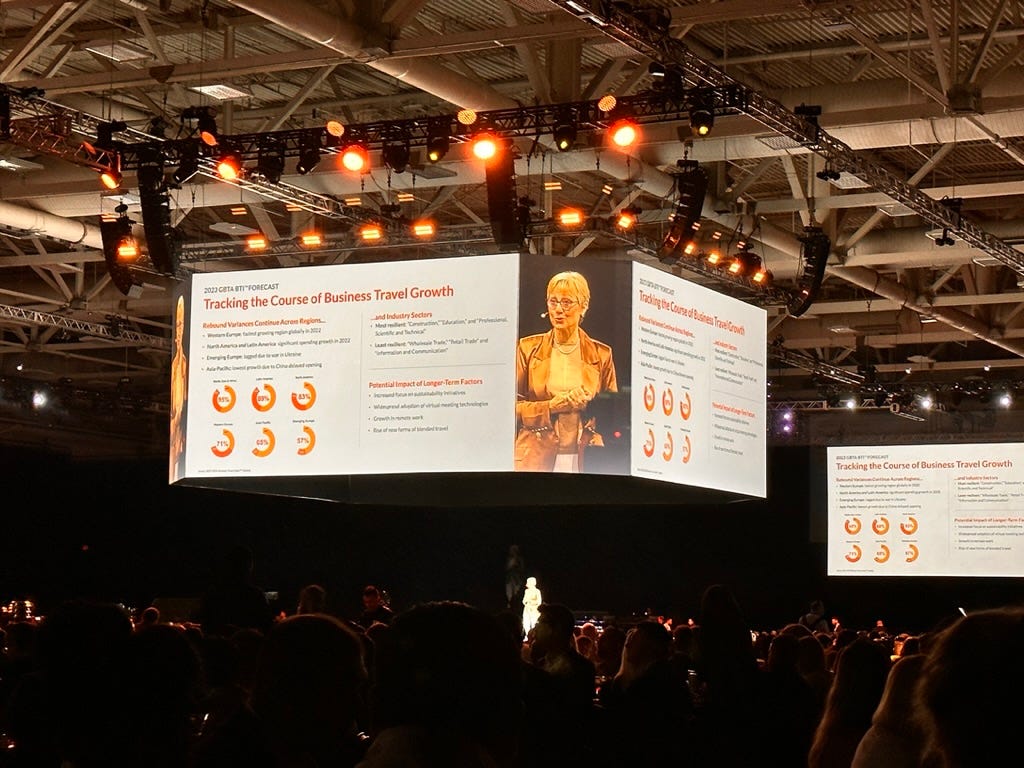
Twice next week, once on Tuesday and again on Wednesday, GBTA will present its Business Travel Index outlook for 2026 through 2030, built on data spanning more than seventy country markets and dozens of industries. I already know the broad shape of what that session tends to say, because I wrote about the same index earlier this year: global business travel spending crossed a nominal record above 1.57 trillion dollars, growth is expected to accelerate again after a softer patch, and the milestone of two trillion dollars in annual spend keeps sliding a year further out than the industry once expected.
What I am more curious about this year is the regional breakdown that gets one slide and thirty seconds of a ninety-minute session, because that slide is doing more work than its screen time suggests. Latin America recovered faster than almost any region after the pandemic, and is forecast to grow more slowly than almost any region over the next five years, for reasons the index describes as structural rather than cyclical. I have argued elsewhere that this framing is accurate and incomplete at the same time, because a spend forecast cannot see the volume of business travel that still happens outside any managed program at all in a region like this one, and because the friction that suppresses the growth number is the same friction that makes professional management worth more per dollar than it is in an easier market. I doubt the BTI session will make that second argument. It rarely does. That gap is exactly why I keep writing about it separately.
The region missing from its own regional session
Here is the detail that stopped me longest while reading through the agenda, and I want to be precise about what it is and is not, because the honest version is more interesting than the exaggerated one.
The program includes a dedicated regional session on Europe, the Middle East, and Africa, walking through pricing forecasts, economic indicators, and priorities specific to that combined region. It includes sessions built around Asia Pacific’s distinct adoption challenges. It does not include an equivalent session built around Latin America. There is no panel asking what a Brazilian, Mexican, or Argentine travel manager needs that a program built for North America or Europe does not already assume.
I want to be fair to the convention here: building a session track is a function of submissions and demand signals, not an editorial judgment about which region matters, and a single year’s absence is not evidence of anything sinister. But it is evidence of something real, and it happens to be the exact thing I have spent this newsletter arguing since its first month: the region gets described in aggregate, is forecast in aggregate, and is, structurally, undersold by exactly the kind of measurement that produces regional session tracks in the first place. A region that does not show up cleanly in the data does not show up cleanly on the agenda either. The gap on the program is a small, honest mirror of the gap in the index.
Why Alagev’s delegation is the real Latin American session
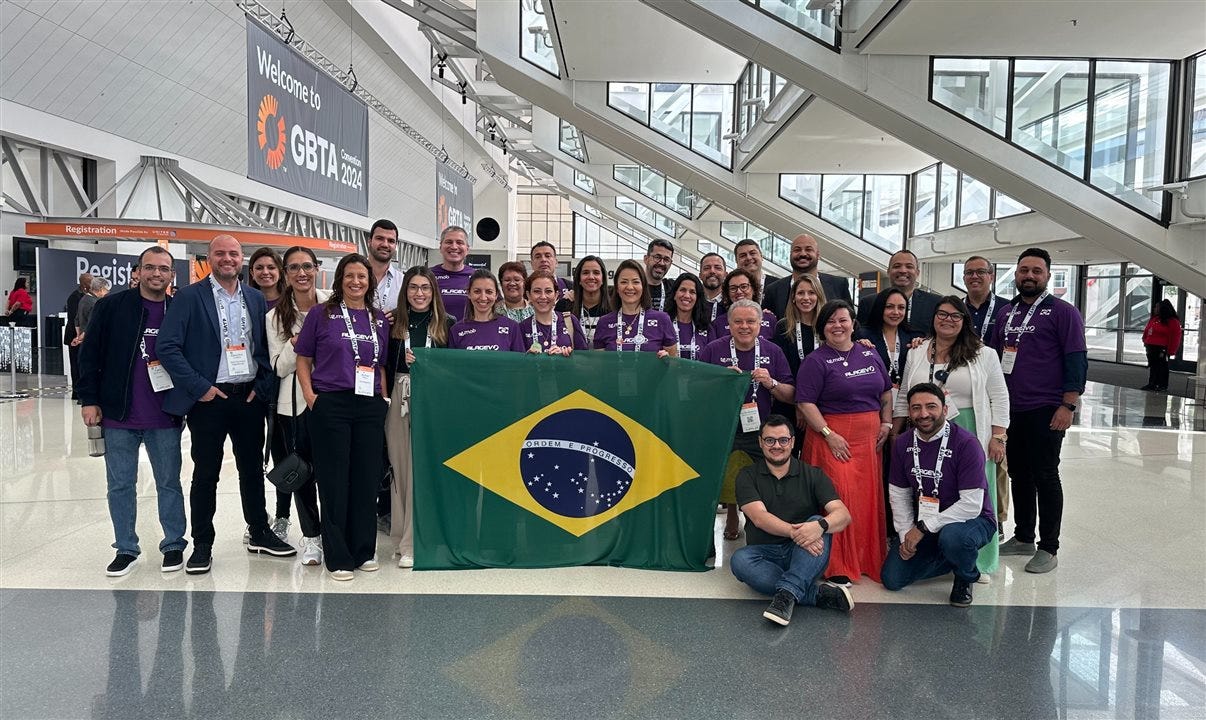
If the official program does not have a Latin America track this year, the unofficial one does, and it is worth being specific about what that actually looked like last year, because the number is not a small one.
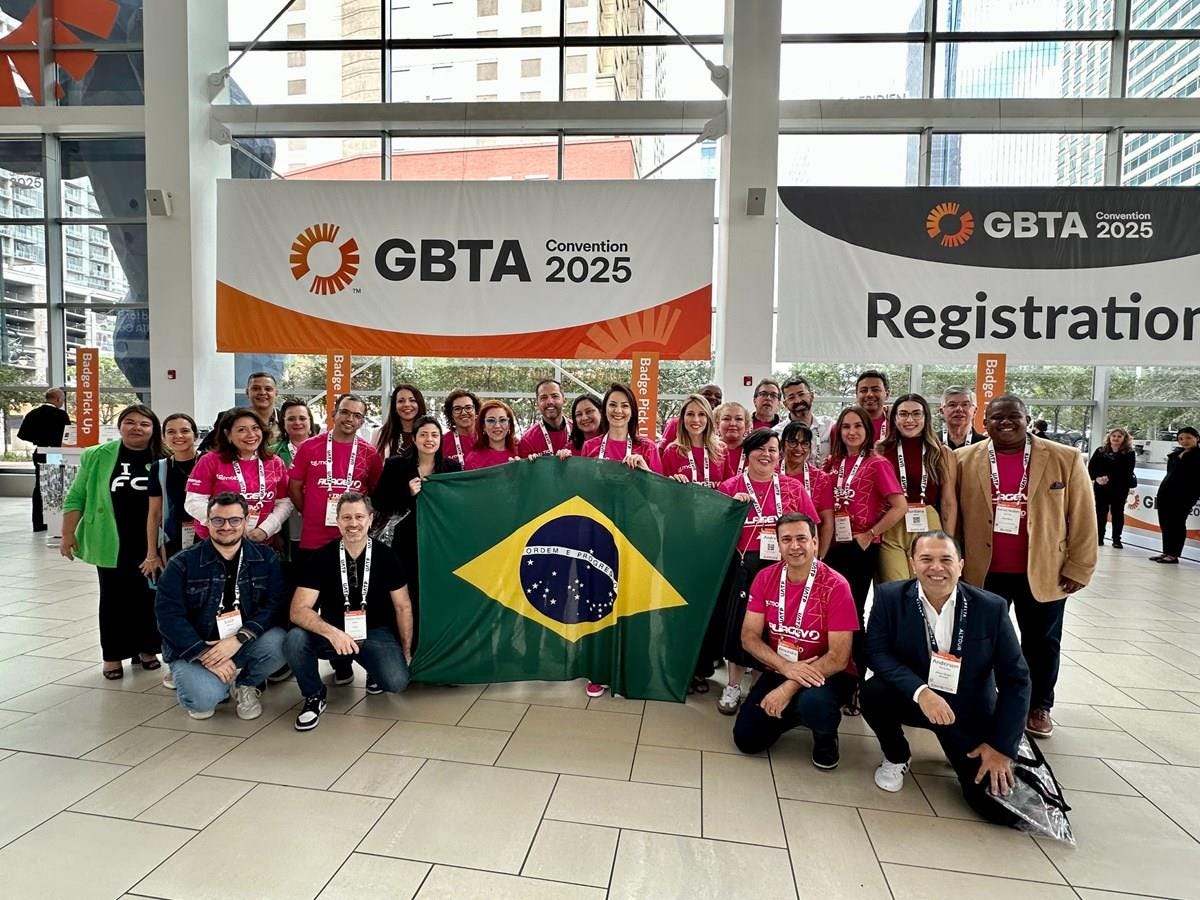
In 2025, Alagev, the Brazilian association I have the privilege of advising, brought the largest Brazilian delegation in the convention’s history to the event: more than sixty professionals from Brazil’s corporate travel industry, in a single coordinated group, at a convention where Latin American attendance has historically been thin relative to the size of the region’s economy. That is not a delegation that shows up to watch. It is a delegation that shows up to be counted, in a room where the official data is still catching up to how much this region actually does.
I do not have this year’s final number yet as I write this, but I will be watching closely to see whether Chicago surpasses Denver, because that trend line matters more to me than almost any single session on the official program. A regional track on an agenda is a curation choice made months in advance. A delegation this size, showing up year after year, is a fact on the ground that no curation choice can quietly leave off the schedule.
The people pipeline no algorithm replaces
There is a whole thread on this year’s agenda that has nothing to do with AI, and I think it is worth naming precisely because of that.
One session brings back a winning cohort from GBTA’s own leadership development program to present their own ideas about the industry’s future, selected from a global group of high-potential professionals. Another is built around mentoring circles rotating through sponsorship, personal branding, and navigating career inflection points, structured as short, focused conversations rather than a single long panel. A third is aimed squarely at people early in their career, walking through a five-step framework for taking ownership of a professional path instead of drifting through it. A fourth tackles something almost nobody puts on a convention agenda directly: networking anxiety, and how to build genuine professional relationships without treating every conversation as a transaction.
None of these sessions will be cited in a market forecast next year. All of them are the reason an industry has a next generation at all, and I think about that thread every time I watch a young Brazilian professional join one of Alagev’s delegations for the first time and realize, somewhere in that first overwhelming expo floor walk, that this industry has room for them in it.
A global shortlist, two seats, and the work in between
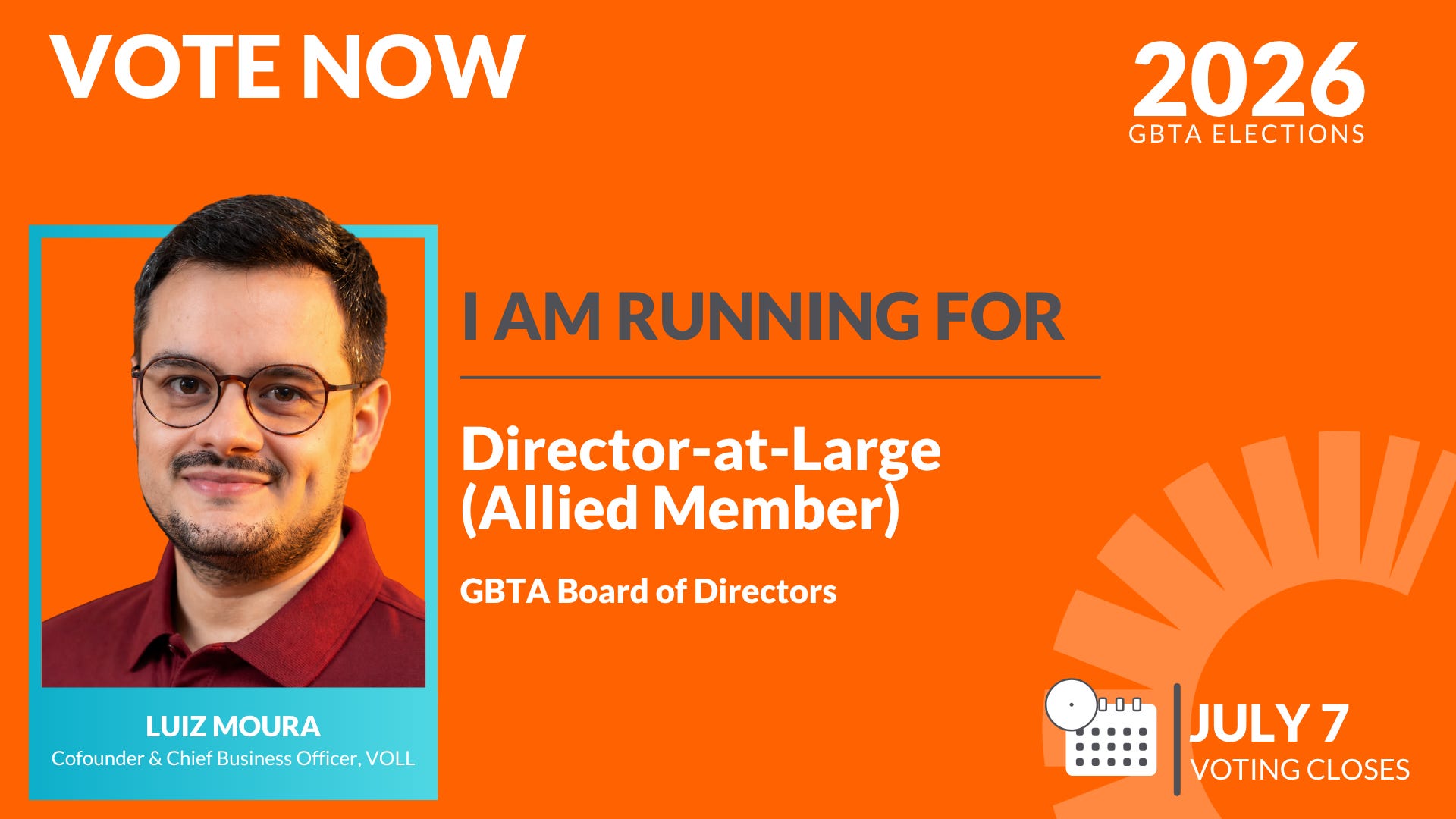
I want to be honest about why I am reading this agenda the way I am reading it, because the vantage point matters and I would rather name it than let it sit unstated.
Being one of ten candidates GBTA put forward for its Global Board of Directors this year does not give me a vote in how a future convention gets built. It does give me something else worth naming: the association that represents this entire industry chose to spend its own credibility amplifying my story, and an amplification like that is not something a person un-hears. I also sit on the tourism council of FecomercioSP, the commercial federation for the state of São Paulo, and in an advisory capacity with Alagev, the same association bringing that Brazilian delegation to Chicago. Between that recognition and those two seats, I have more reason than most to notice a missing regional track instead of reading past it, and to think the industry’s own data infrastructure, not just its convention programming, has a Latin America problem worth naming out loud, repeatedly, in public.
I have made versions of this argument in interviews with Forbes Brasil and EXAME over the past year, and I write a regular column for some of the largest business outlets in Brazil that returns to it often, because repetition is sometimes the only way an unmeasured region gets measured. VOLL, the company I co-founded and now help lead as Chief Business Officer, exists inside that same argument: the thesis that a market underserved by global benchmarks is not a small market, it is a market that has not finished being counted. Chicago, and specifically its blank space where a Latin America track should be, is one more data point for an argument I plan to keep making for a long time.
The border sessions nobody wanted to need
A handful of sessions this year exist only because the operating environment around travel got harder, not because anyone on a program committee wanted to program them.
One session walks through recent changes to the Electronic System for Travel Authorization, the entry requirements international travelers now face even when arriving from countries in the visa waiver program, alongside a conversation with a sitting member of Congress about what is actually moving through Washington. Another looks specifically at how evolving trade and immigration rules are reshaping cross-border business travel between the United States, Canada, and Mexico, from workforce mobility to supplier relationships. A third steps back to the broader picture, framing immigration and entry policy as an increasingly complex variable that travel programs now have to plan around rather than treat as background noise.
I am not going to editorialize about the policy substance here, because that is not what this newsletter is for and because the sessions themselves are carefully framed as operational, not political. What I will say is that a convention program is a reasonably honest mirror of what buyers are actually losing sleep over, and the fact that border and entry complexity earned three separate sessions this year, none of which existed in this form a few conventions ago, tells you something real about how much harder the compliance side of this job has gotten, independent of anything AI is doing to the booking side of it.
The people the rest of the agenda forgets
Buried a few rows down from the sessions that will get quoted in every recap is a smaller cluster that deserves better than the attention it usually gets, because it is about who a travel program is actually built for.
One session addresses hidden disabilities directly: travelers managing ADHD, autism, anxiety, or sensory sensitivity, often without ever disclosing it, and what a program can do to support them without requiring a medical label as the price of accommodation. Another takes accessibility further, framing it as a design principle for products, services, and environments rather than a compliance checkbox, and walking through what it actually takes to make both the digital and physical parts of a trip usable for a traveler with a disability. A third looks at extended stay travel, the trips that stretch from days into weeks or months, and argues that a traveler thirty nights into a relocation needs something closer to a support system than a hotel room, with productivity, safety, and well-being becoming the real measures of whether the accommodation worked.
None of these travelers show up as a distinct line in a spend report, and none of these sessions will be mistaken for the main event. But an industry that spends a week debating how much autonomy to hand an algorithm should probably also spend a few hours asking who its policies were quietly built to exclude, and this year’s program, to its credit, sets aside exactly that much time for it.
The trust economy
A last thread running underneath almost everything else on this agenda is about trust specifically, named as such, treated as an asset rather than an assumption.
One workshop uses a framework its presenters call the Circle of Trust, mapping supplier relationships along four dimensions to diagnose which partnerships are solid, which are fraying, and what it actually takes to earn a place inside the circle rather than at its edge. Another looks at the unglamorous stretch of a partnership that begins the day after a contract is signed, when joint planning, shared data, and ongoing education either happen or quietly do not, and asks whether AI can genuinely serve as a co-pilot for keeping that harder, later work on track. A third, on the hospitality side I wrote about earlier, argues that the transactional model built around annual rate negotiations is reaching its limit precisely because it was never built to hold trust, only price.
Every other thread on this program, agentic AI governance, program value, hotel rate visibility, is really a version of the same question asked in a different room: who gets trusted with how much, and what does an institution have to prove before it earns that trust rather than assumes it. A convention that puts a session called the Circle of Trust on the same agenda as a session asking who decides what an AI agent may do is, whether it planned to or not, making the same argument twice.
The unglamorous sessions that will matter more than the keynotes
Every convention has a handful of sessions that will not make anyone’s recap thread and that I nonetheless flag every year, because the texture of an industry lives in its unglamorous rooms.
There is a session built entirely around how the FAA actually functions, aimed squarely at buyers who want to understand air traffic control and safety oversight well enough to manage disruption instead of just reacting to it, a topic I have written about at length because so few people outside operations ever bother to learn it properly. There is a session, delivered with more humor than the topic usually gets, that promises to retire service-level metrics that have not been rethought since the era of flip phones and dial-up, which is a funnier way of making a serious point about how badly some KPIs have aged. There is a session, co-developed with Waymo, asking whether travel risk frameworks are actually ready for driverless taxis, which sounded like science fiction the first time I saw it on a convention program a few years ago and does not anymore. And there is a session built around a real evacuation case, walking through how insurers, underwriters, assistance providers, and internal teams actually coordinated when a crisis unfolded on the ground, which is the kind of session that only matters once, on the one day a program needs it, and matters enormously on that day.
None of these will trend. All of them are the kind of session that changes how a travel manager runs their Tuesday six months from now, which is a better test of a convention’s value than any keynote applause line.
The two men closing the stage
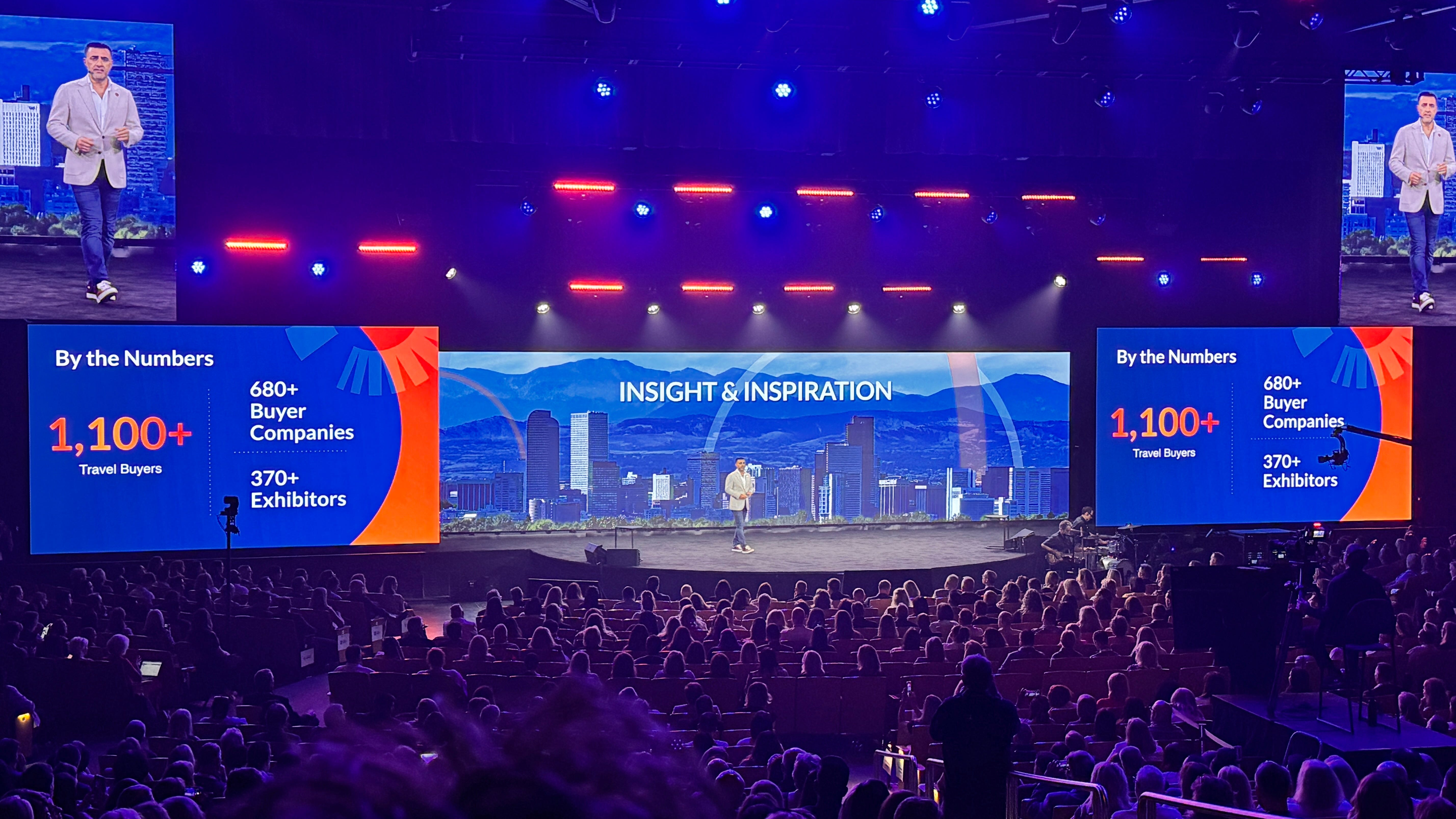
The convention ends, on both its main days, on leadership rather than logistics, and I think that choice is worth sitting with.
Tuesday’s Main Stage closes with Frances Frei and Anne Morriss, whose entire body of work argues that the leaders who move fastest are not the ones who cut corners but the ones who build trust quickly enough that speed stops being reckless. Wednesday’s closes with José Andrés, a chef whose disaster-relief organization has put him on front lines most industry keynote speakers will never see, talking about leadership under the kind of pressure that has nothing to do with quarterly targets.
I do not think it is an accident that an industry spending a week arguing about how much authority to hand an algorithm chooses to close both of its biggest stages with human beings talking about judgment, trust, and showing up in person when it is hardest. I have made a version of this argument before, that the right frame for this technology is amplification of people, never their replacement, and a convention that puts Frei, Morriss, and Andrés at the very end of its two biggest days is making the same argument in its own language, whether or not it says so out loud.
What I will be watching for, and why
So here is what I actually plan to do with the next few days, beyond the sessions I have already flagged above.
I want to see whether the agentic AI governance conversation and the ROI conversation ever openly acknowledge that they are the same argument wearing two different names, because right now the program treats them as separate tracks and I do not think they are. I want to see what the Business Travel Index session says about Latin America out loud, versus what sits quietly in a footnote of the slide deck, because the gap between those two is usually where the real story lives. I want to see whether the sustainability sessions keep their new arithmetic tone once the questions from the floor start, or drift back toward advocacy under pressure. And I want to see whether this year’s Alagev delegation is larger than last year’s, because that number will tell me more about where this region is actually headed than any forecast will.
I will write about all of it once the week is over, and I expect that piece to read very differently from this one, because a program read in advance is a set of intentions and a convention lived through is always something messier and more honest than its own agenda promised. That gap, between what an event says it will be and what it turns out to be, is usually the most interesting thing about it.
Back to the suitcase
So the blazer question gets decided the boring way, by whichever one survived the last trip in better shape, and the suitcase gets closed.
I have read this agenda the way I read most things now, professionally and a little suspiciously, looking for the argument underneath the schedule rather than the schedule itself. What I found is an industry mid-fight with itself over how much to trust a new tool, an industry quietly getting more rigorous about sustainability and hotel value than it gets credit for, still bad at proving its own worth in the language finance actually speaks, and a region I care about more than most showing up, once again, in the unofficial numbers rather than the official program. Chicago will confirm some of that, complicate some of it, and probably surprise me in ways no advance reading ever manages to predict. That is, more or less, why I keep going.
About me

I am an entrepreneur with over 20 years of experience at the intersection of tourism and technology. I am co-founder and Chief Business Officer of VOLL, the largest mobile-first corporate travel and expense management platform in Latin America, and a recognized reference in the development of the corporate travel industry.
A Marketing specialist from Fundação Dom Cabral, I serve on the Tourism Council of FecomércioSP and on the Executive Council of the Latin American Association of Corporate Events and Travel Management (Alagev). A frequent traveler and close observer of human behavior in motion, I write and speak about innovation, digital transformation, entrepreneurial leadership, and the future of corporate travel.