



Business Travel News named Jennifer Steinke of Moderna its Travel Manager of the Year for 2026, and almost every summary of the news led with the same two letters: AI. I understand the reflex, and I also think it buries the real story. I had watched Steinke present from more than one conference stage, in Dallas, in Atlanta, in Denver, before I ever spoke with her in Chicago, and the thing that stayed with me was never a piece of software. It was a way of thinking.
The recognition she earned is being read by the industry as a story about artificial intelligence. It is really a story about a person who used it well. That distinction is not pedantic. It decides whether a company’s AI spending turns into a better program or an expensive disappointment, and it points straight at the one role most likely to be underestimated in the whole transformation.
I should declare my stake before I go further, because I have a large one. I am co-founder and Chief Business Officer of VOLL, Latin America’s largest corporate travel and expense management platform. We host an annual event, Travel Connect, where fifteen hundred corporate travel professionals gather, and this year we launched an agentic AI product of our own. So I am not a neutral observer of where AI is heading in this field.
That is exactly why I want to argue against the thing my own industry keeps selling, which is the idea that the tool is the protagonist. It is not. The person orchestrating it is.
What a great travel manager actually did with AI
Look closely at what earned Steinke the award and you find something more interesting than a purchase. As Director of Travel, Meetings and Fleet at Moderna, she did not adopt one clever tool. She composed several into a system that did not exist before. She wired together a natural-language booking engine, an analytics layer, a mid-size travel agency as her fulfillment partner, and a proprietary platform of her own design that she calls TAMI, for Travel and Meetings Intelligence, which weighs the total cost of a trip against a traveler’s loyalty status at the moment of booking.
The most quietly radical piece is what she named the Policy of One. Instead of a single rulebook applied to everyone, dynamic traveler profiles generate personalized, policy-permitted options that account for lounge access, upgrade probability, baggage fees and the small realities that decide whether a trip is good or miserable, with an instant benchmark at the point of sale that gives the traveler a gut check on cost before they commit. Her stated ambition is almost humble in its scope: “everyone will go to TAMI for everything that we need for travel.”
None of that came out of a box. She saw a problem the market had not solved and assembled the answer. That word, assembled, is the one I would underline. She was less a buyer than a builder, treating the AI tools as raw components and the traveler’s real experience as the specification. Most programs never get there, because most programs are waiting for a single product to arrive and solve everything, which is not how any of this works.
The tool did not have the idea, the manager did
This is the distinction the headlines flatten. AI did not decide that a rigid, one-size policy was failing Moderna’s travelers. AI did not choose which vendors to trust, which data to feed the model, which trade-offs mattered, or where a human still had to sign off. A person made every one of those calls, and the software executed them. Every one of those was a judgment, and judgment is the one component of this whole system that cannot be downloaded, benchmarked or bought.
The lesson I keep taking from the best work in this field, and it is the same lesson I took from an executive program on the AI-powered organization I finished this year, is that AI is an input, not an output. It is astonishing at prediction and generation, and useless at judgment, ownership and taste. Those remain human, and in a corporate travel program they live in one specific chair.
Give the same set of AI tools to two travel managers and you will get two completely different programs, because the value was never evenly distributed between the human and the machine. The industry’s own numbers hint at this, with strong interest in AI paired with thin real adoption, a gap that is not about access to the models, which everyone now has, but about who has the clarity to put them to work.
The value was concentrated in the person who knew the travelers, understood the politics of the company, could tell a real constraint from a lazy rule, and was willing to own the result. The model is a commodity. The judgment around it is not.
In Brazil, the same thing is happening, mostly unseen
Here is what almost never makes the global roundups. The exact story the industry is celebrating in the United States is being written, right now, by travel managers across Latin America, and hardly anyone outside the region is watching.
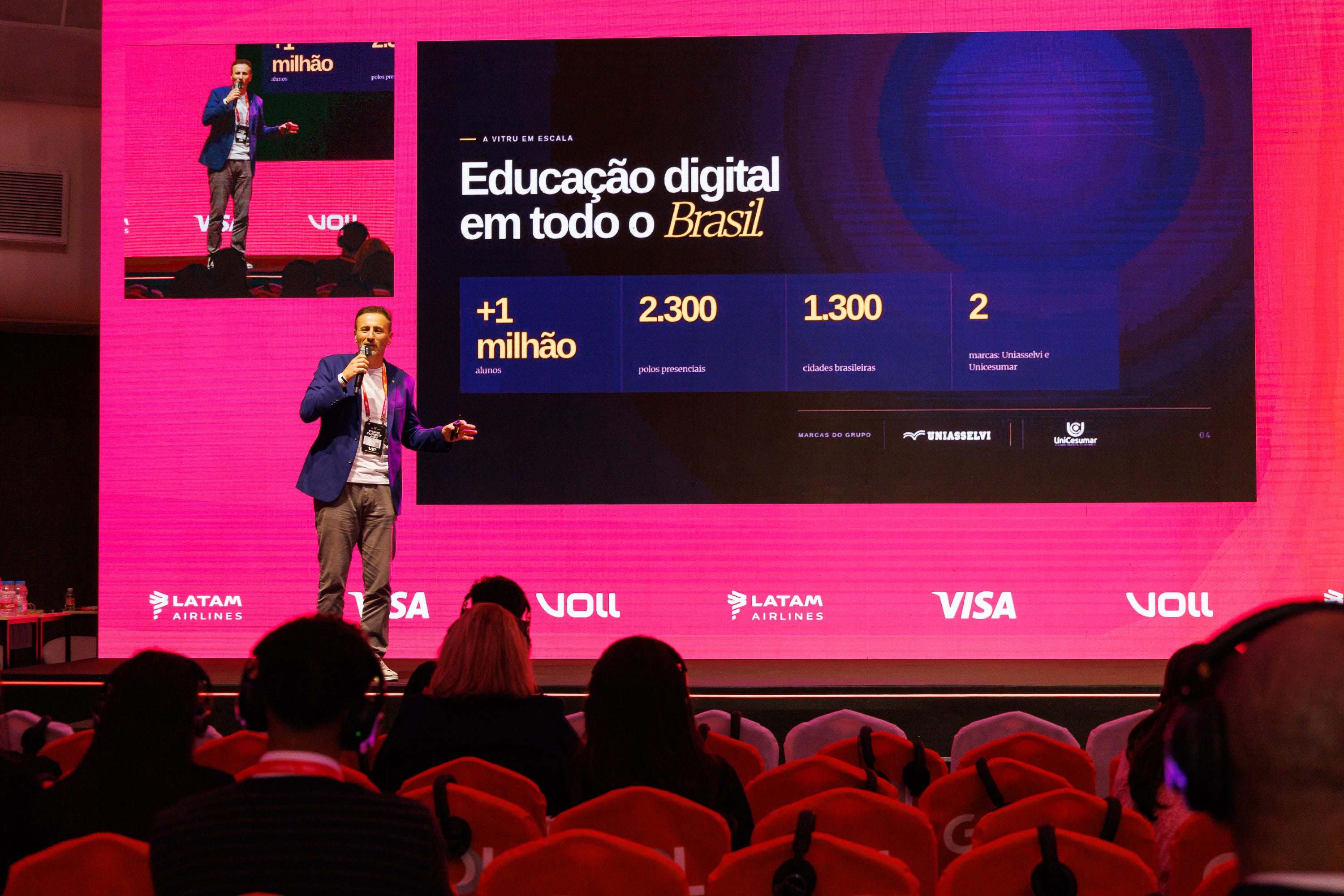
When we hosted Travel Connect in São Paulo this September, fifteen hundred people filled the room, and the overwhelming majority were not vendors. They were the people who run travel inside Brazilian companies, and the conversation on stage was not whether AI mattered but how to hold it accountable, how to keep a human in the loop, how to turn data into a decision instead of a dashboard.
We launched VOLL Intelligence, our agentic AI for travelers and managers, into that room precisely because the appetite was already there. The managers were not waiting to be convinced. They were waiting for tools worthy of what they had already figured out. I have sat through enough of these conversations, on both continents, to stop being surprised by the level in São Paulo and start being frustrated that so few people outside the room ever hear it.
Let me make it concrete, because the abstraction does these people a disservice. Tiago Póvoa runs the shared services center at Vitru Educação, and he is one of the leaders who switched on an agentic AI process inside his company’s travel and expense operation with us. In his own account to Exame, the program now verifies every voucher automatically and reaches out to the traveler on its own when something needs correcting, with no human touching most of the flow, which has shortened approval and reimbursement delays and lifted routine work off his finance team.
The sentence of his I keep repeating is not about efficiency at all. “We are not just doing better what we already did,” he said. “We are now doing things we simply could not do before.” That is a travel and expense leader describing a capability that did not exist for him a year ago, and he, not the software, is the one who decided to build it. The appetite and the ambition behind that decision match anything I have seen on a North American stage. The only real difference is who gets handed a microphone in front of a global audience.
What these managers have that a model never will
Strip the technology away and ask what a travel manager actually brings, because it is precisely the list that AI cannot supply. They carry the context of how their company really works, the relationships with travelers who trust them, the judgment to know when a cheaper fare is a false economy, the accountability when something goes wrong at midnight in an unfamiliar city, and the standing to say no to a policy that looks efficient on paper and fails a human in practice. Those are the same scarce goods that decide whether any AI deployment succeeds or quietly gets routed around, which is why the research we published with Panrotas and Visa keeps pointing back to the human layer even when the topic is automation.
A model can draft a policy in seconds. It cannot be trusted by a nervous first-time traveler, cannot absorb the blame for a missed connection, and cannot decide that this quarter the company will spend a little more to keep its people safe and sane. The manager is not the part of the system that AI replaces. The manager is the part that makes the AI worth having. This is also why the honest way to sell a tool like ours is not to promise that it replaces the manager. It is to promise that it gives a good manager more reach, and that it gets out of the way of their judgment rather than pretending to substitute for it.
The recognition gap is a Latin American story
There is a pattern worth naming, and it is the flagship point of everything I write. The awards, the case studies, the magazine covers in this industry are overwhelmingly North American and European. Brazil is now the fastest-growing corporate travel market among the world’s largest, with spending around 35.8 billion dollars and double-digit growth, and the professionals managing that surge are doing work every bit as inventive as the work that wins trophies elsewhere. The gap is not talent. The gap is who gets seen.
That is a problem I am in a position to do something about, and I intend to. Part of the reason we build in the open, publish our data, and put a real event in front of fifteen hundred managers a year is that this community deserves a stage proportional to its ambition. The industry gathered in São Paulo is not a follower market catching up to a northern template. It is a peer, occasionally a leader, and almost always underreported. The consequence is quiet but real. Global vendors design for the markets they can see, best practices calcify around a northern default, and a generation of Latin American managers ends up bending tools built for someone else’s assumptions into shape.
The people writing the real stories
So here is my correction to the headline. The most important AI story in corporate travel is not a model release or a feature list. It is a travel manager, in Boston or in São Paulo, who looked at a broken process and decided to fix it, then used whatever tools were available, artificial intelligence included, to build something better than the market handed them. Jennifer Steinke earned her award for exactly that, and she deserves it. The managers I watch in our own community are doing the same work, often with less recognition and more constraint, and they deserve it too.
My company will keep building the tools, and I will keep saying the part the technology press tends to skip. The AI did not save the traveler. A person did, with help. If you run travel for your company and you are quietly stitching intelligence into a program that used to be a spreadsheet and a prayer, you are not a user of someone else’s product. You are the author of the story, and the tool is just your pen.
That is not a sentimental point, it is the most practical one I know. A company that invests in its people’s judgment is buying the only part of this that compounds, while a company that buys a model and neglects the person operating it has purchased an expensive way to make the same mistakes faster. I would rather celebrate you than the software any day, and I have already started, with people like Tiago Póvoa who are willing to go on the record, because those stories are the best argument this industry has for where it is going, and they are the argument I most want to make.
About me

I am an entrepreneur with over 20 years of experience at the intersection of tourism and technology. I am co-founder and Chief Business Officer of VOLL, the largest mobile-first corporate travel and expense management platform in Latin America, where I lead the commercial strategy behind our AI adoption.
A first-cohort graduate of The AI-Powered Organization at Stanford Graduate School of Business and a Marketing specialist from Fundação Dom Cabral, I serve on the Tourism Council of FecomércioSP and on the Executive Council of the Latin American Association of Corporate Events and Travel Management (Alagev). I write and speak about innovation, digital transformation, entrepreneurial leadership, and the future of corporate travel.