



I read airline income statements for fun, which probably tells you more about me than I should admit in the first line. So when McKinsey published a teardown of the economics of a single flight, I went straight for the numbers. The piece walks through a hypothetical one-way Boeing flight from London to New York, and the result is the kind of thing every business traveler should see once, because it quietly demolishes the assumption most of us carry to the airport. McKinsey’s breakdown puts total revenue for that flight at about $174,093 and total costs at about $152,817, which leaves an operating profit of roughly $21,276, a margin of 12.2%.
Twelve percent sounds healthy until you learn two things. First, this is a premium transatlantic route with an unusually favorable mix of business and premium cabins, which is close to the best case an airline gets. Second, the industry as a whole does nowhere near that. I run a company that sells travel efficiency, so treat everything I am about to argue with that interest in mind.
I co-founded VOLL, Latin America’s largest corporate travel and expense management platform, and I have a stake in how companies think about this cost. But the interest does not change the math, and the math is the point. The airline is not getting rich on your ticket, and understanding why is the most useful thing a corporate buyer can do with ten minutes.
The teardown, dollar by dollar
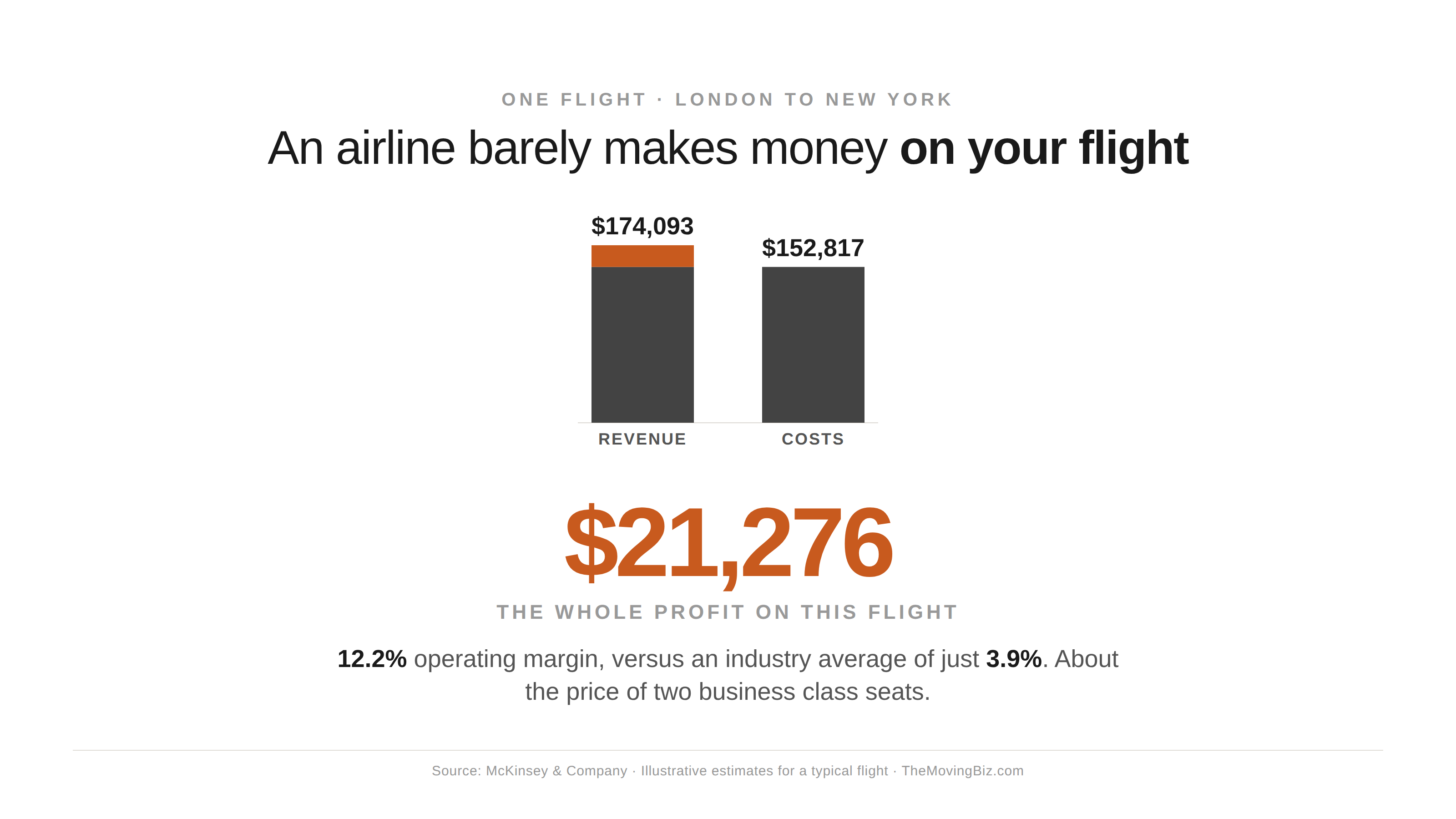
Start with where the $174,093 comes from. Tickets are the bulk of it, at about $160,470, spread across a cabin that in this example holds roughly 192 economy seats, 35 premium economy and 31 business seats, with business alone contributing about as much as all of economy. On top of the fares sit two smaller lines that matter more than they look: cargo at about $7,000 and ancillaries at about $6,623, the bags, seat selection and onboard sales. Together they lift the total past what the seats alone would earn.
Now the costs, and this is where the romance of flying meets the spreadsheet. Fuel is the single largest line at about $50,843, roughly a third of the total. Then come airport costs at about $35,000, the aircraft lease at about $25,090, maintenance near $10,360, and a long tail of smaller items: cabin crew, pilots, passenger-related costs, marketing, ground handling, air traffic control and overheads. None of those is optional. Add them and you reach the $152,817 that has to be covered before the airline keeps a cent.
The gap between that and the revenue is the whole profit, and on this flight it is about the price of two business class seats. On a worse day, with a delay, a half-empty cabin or a fuel spike, that gap closes fast.
Even the good flight barely clears 12%, and most do worse
Here is the context McKinsey’s single flight cannot show on its own. The whole global industry is forecast to earn a net margin of just 3.9% in 2026, according to IATA. Airlines will post a record net profit of around 41 billion dollars on revenues approaching one trillion, and that headline record still leaves the thinnest of buffers, which works out to only a few dollars of profit per passenger carried. IATA’s own economists titled a recent report almost exactly that way, noting that profits hit a record high while margins stay thin.
Sit with that comparison for a second. A supermarket runs on margins like these and nobody accuses the grocer of gouging. Yet airlines attract the suspicion of a cartel while operating one of the least profitable businesses at scale in the modern economy.
The 12.2% in the McKinsey example is the flattering exception, a premium route in a good configuration. The 3.9% is the truth of the average flight, and plenty of routes lose money outright and survive only because another route in the network subsidizes them.
Tickets are not where the money is anymore
The most strategically important detail in the teardown is how small the extras look and how much they matter. Cargo and ancillaries added only about $13,623 to that London to New York flight, less than a tenth of revenue, and yet on a 3.9% margin business, a tenth of revenue is several times the entire profit.
The extras are not a rounding error. They are frequently the difference between a flight that makes money and one that does not.
Zoom out and the pattern is unmistakable. Global airline ancillary revenue reached an estimated $148.4 billion, according to IdeaWorks and CarTrawler, and it keeps growing at double digits. Cargo tells a similar story, since a large share of the world’s air freight travels in the belly of passenger jets, quietly earning while you watch the safety demo. What this means for a travel program is subtle but real.
When you book only the fare and manage nothing else, you are interacting with the least profitable part of the airline’s business while ignoring the levers, bags, changes, seats, that the airline has deliberately made profitable. The fare is the honest price. The extras are where both sides now play.
Fuel is the tyrant of the whole statement
If one line explains the volatility that frustrates every travel manager, it is fuel. At about a third of total costs on the McKinsey flight, and even higher on many routes, fuel is the biggest single expense and the one airlines control the least. It is priced off oil and the exchange rate, and it moves faster than any airline can adjust schedules or fares.
When fuel jumps, a 3.9% margin does not have room to absorb it, so the airline does the only things it can, which are to trim capacity and let the cheapest fare buckets sell out sooner. That is why a fuel shock reaches you not as a neat surcharge but as fewer cheap seats and a jumpier price. The margin is too thin for anything gentler.
This is the quiet link between the airline’s problem and yours. The company that understands fuel sits underneath the fare stops waiting for the airline to absorb a cost it structurally cannot, and starts managing the parts of the trip it actually controls.
What a thin margin means if you buy corporate travel
Put the pieces together and a strategy falls out of the numbers. If airlines earn 3.9%, there is almost no fat in the fare for anyone to squeeze, which means the old procurement instinct of leaning on the carrier for a better headline price has a hard floor, and you hit it quickly. The savings that actually move a travel budget do not come from the airline surrendering margin it does not have. They come from your own side of the transaction.
They come from booking earlier, so you buy the cheap fare classes before capacity discipline empties them. They come from steering trips into policy, from consolidating suppliers where you have volume, from managing the ancillaries the airline has turned into profit centers, and from seeing your total spend clearly enough to negotiate from evidence.
This is the same conclusion I keep reaching from different directions, and it is not a coincidence. When the counterparty runs on 3.9%, efficiency has to be manufactured on your side of the table. The airline is not your piggy bank. Your own discipline is.
The Latin American footnote
One caveat that matters to my part of the world. McKinsey modeled London to New York, one of the most competitive and premium-rich routes on the planet. There is no equivalent public teardown for a São Paulo to Manaus or a Bogotá to Lima, and the economics there are harsher, not gentler. Fuel is a larger share of costs in Latin America than in North America, competition on many domestic routes is thinner, and currency swings hit carriers whose costs are dollarized while their revenue is not.
In Brazil the average domestic fare recently climbed to its highest level since 2024, and the pressure behind it is the same thin-margin reality, only sharper. If a 3.9% cushion is tight on a transatlantic route, it is tighter still on a regional one with less competition and more volatility. The lesson for a Latin American travel program is the London to New York lesson with the volume turned up.
The airline is not the villain, and it is not the answer
I find airline economics fascinating for the same reason I find them useful. They puncture a comfortable story. The narrative that fares are high because airlines are greedy does not survive contact with a 3.9% net margin, and the buyer who believes it will waste energy fighting the wrong battle.
The airline is running a brutal, capital-heavy, fuel-exposed business on margins a software company would consider a rounding error, and it has already optimized the parts it controls.
That is not a reason to feel sorry for airlines, which are large and capable of looking after themselves. It is a reason to be precise about where your leverage actually lives. It does not live in the fare, which the airline has already cut close to the bone. It lives in how well you plan, how tightly you manage policy, how completely you see your own spending, and how early you act.
The next time a fare makes you wince, remember that the airline probably kept about a coffee’s worth of profit from carrying you. What you overpay, you overpay to your own disorganization, and that, unlike the price of oil, is a number you can actually change.
About me

I am an entrepreneur with over 20 years of experience at the intersection of tourism and technology. I am co-founder and Chief Business Officer of VOLL, the largest mobile-first corporate travel and expense management platform in Latin America, where I lead the commercial strategy behind our AI adoption.
A first-cohort graduate of The AI-Powered Organization at Stanford Graduate School of Business and a Marketing specialist from Fundação Dom Cabral, I serve on the Tourism Council of FecomércioSP and on the Executive Council of the Latin American Association of Corporate Events and Travel Management (Alagev). I write and speak about innovation, digital transformation, entrepreneurial leadership, and the future of corporate travel.