


In August 2026 the average domestic airfare in Brazil reached R$ 776.87 per segment, the highest level since December 2024, when it sat at R$813.80. That is according to ANAC data reported this week, and the move is not gentle. The average is up 14.5% over twelve months and nearly 11% in a single month. For a large company, air travel is one of the heaviest lines in the entire cost base, sitting close to payroll and technology in many budgets. A jump of this size is not a rounding error. It is a number that reaches the board.
I should be honest about where I stand before I argue anything, because it shapes the argument. I run a company that sells travel efficiency. I am co-founder and Chief Business Officer of VOLL, Latin America’s largest corporate travel and expense management platform, backed by Warburg Pincus, which took a controlling stake in a deal above USD 120 million.
When airfares hit a two-year high, the easy move for someone in my seat is to promise that better software will make the ticket cheaper. It will not, and I am not going to pretend otherwise. The fare itself is mostly outside any single company’s control. What I want to show is where the efficiency actually came from for the businesses that absorbed this increase without watching their travel budget detonate, because none of it was a cheaper fare.
It was everything around the fare. None of the levers below is exotic, and that is the point, because the companies pulling ahead are simply doing the ordinary things with far more discipline than everyone else.
The fare is the part you do not control
Start with why the ticket rose, because it explains why fighting the ticket is the wrong instinct. The dominant force is jet fuel. Aviation kerosene reached about R$4.98 per liter in August, and ANAC data shows it climbing faster than fares themselves. Fuel is priced off oil and the exchange rate, neither of which responds to how hard your travel team negotiates. Add capacity discipline from the airlines, and you get a yield per kilometer that rose 12.2% against its own recent average.
There is one detail in the ANAC breakdown that matters more than the headline, and it is the hinge of this whole article. The average did not rise only because every seat got pricier. It rose because the cheap seats got scarcer. Only 34.8% of seats were sold at R$500 or less in August, down from an average of 47.2% in the prior period.
The floor did not vanish. It shrank. That distinction is everything, because it means part of the increase is not a wall you hit, it is a competition for the good inventory that some companies keep winning and others keep losing.
It also helps to zoom out before anyone panics. Over a longer horizon, in real terms, the government has pointed out that airfares have actually fallen over the past three years. So the honest framing is not runaway inflation. It is volatility, sharp and hard to predict, on top of a line item too big to ignore. Volatility is a management problem, not a reason for despair, and it rewards preparation in a way that steady prices never did. You cannot out-shop fuel. You can absolutely out-manage volatility. That is the entire opportunity.
Knowing how an airfare is built is already a saving
The first lever costs nothing but expertise. An airfare is not one price, it is a ladder of fare classes that empty from the bottom up. When 47% of the cabin sold cheaply and now only 35% does, the teams that understand that ladder book into the lower rungs before they disappear, and the teams that book reactively pay for the rungs that are left.
Same flight, same day, very different cost, decided entirely by knowledge and timing. Capacity discipline makes this sharper every year. When airlines hold seats tight, the cheapest fare classes sell out faster, so the cost of hesitation rises for everyone, and the reward goes to the team that knows the route, the season and the booking curve well enough to move first.
This is why planning beats negotiating in a volatile market. Booking earlier is the least glamorous lever in corporate travel and one of the most reliable, with specialists estimating that disciplined advance purchase can trim double digit percentages off trip cost, and you should read any single vendor number with caution while keeping the direction, which is not in dispute. In our own base we have measured how steep the penalty gets for leaving at the wrong moment, with the most expensive departure slots costing far more than a midweek alternative on the same route.
A company that plans its travel a week earlier is running a different pricing environment than one that books the night before, without changing a single supplier contract. Twenty years in this sector taught me that most of what looks like a pricing problem is really a planning problem wearing a disguise.
Structured data is the line between managing travel and hoping

You cannot manage what you cannot see, and most travel programs are half blind. A large share of corporate travel spend still happens off channel, booked on personal cards and reconciled weeks later, invisible to the people who are supposed to steer it. When the fare is stable, that blindness is expensive. When the fare is spiking, it is dangerous, because you are absorbing an increase you cannot even measure.
This is where structured data stops being an IT nicety and becomes a cost lever. In the study my company publishes with Visa and Panrotas, reported by InfoMoney, a real part of what looks like rising spend is simply spend becoming visible for the first time as companies move onto real platforms. That sounds like an accounting curiosity until you realize the reverse is the actual danger: the spend you cannot see is the spend you cannot control. Structured, unified travel data is what lets a company negotiate from evidence, enforce a policy that means something, forecast the next quarter instead of explaining the last one, and know which routes and which behaviors are quietly carrying the increase. The company that measures can manage. The one that cannot is just receiving invoices and hoping.
There is a compounding effect here that most finance leaders underestimate. Clean travel data does not only reduce this year’s spend, it improves every negotiation, every forecast and every policy decision that comes after, because each of those is only as good as the evidence beneath it. A program that finally sees itself tends to keep finding savings long after the first cleanup, which is the opposite of a one time cut.
Policy, culture and communication compound quietly

The largest savings in a travel program are rarely a single clever negotiation. They are behavioral, and they accumulate. A clear travel policy, consistently applied, does more to protect a budget than any one supplier deal, which is why GBTA’s own research keeps finding that technology and managed travel gaps are what stall progress toward a well-run trip. Policy sets the rails. Culture decides whether people stay on them.
A culture of austerity, and I mean the healthy kind, is when employees treat the company’s money with the same care they treat their own, not because a rule forces them but because it is simply how the organization thinks. That culture cannot be bought, but it can be built, and it is built largely through communication. The most underused lever in this entire list is talking to travelers at the moment of decision, when someone is choosing a flight and a gentle nudge toward an in policy, lower cost option lands while it still matters. A policy nobody reads changes nothing. A well timed message changes the booking. When the fare is rising, the company that has spent years explaining the why to its people pays measurably less than the one that only sends rules.
The mechanics are unglamorous and they work. A traveler who books inside the approved channel is visible, comparable and covered by whatever rates the company negotiated. A traveler who steps outside it takes the program’s leverage with them, one booking at a time, and the sum of those small exits is usually larger than any single line the finance team is actively watching.
AI is the newest lever, and still the least used
Now the part I am closest to, so read the disclosure again. There is a real gap between how much the industry talks about artificial intelligence and how little it has actually deployed. GBTA’s own surveys show strong interest but limited real adoption, which is exactly why it is a lever and not yet a commodity. The advantage still belongs to whoever moves.
Used well, AI does the unglamorous work that humans do slowly and inconsistently: watching fare movements across a whole program, flagging a booking that broke policy before it is ticketed, spotting an anomaly in an expense, forecasting spend by route, and giving a traveler an in policy answer in seconds instead of a form to fill. This is where the broader business travel market is heading, with the 2026 GBTA forecast tying part of the region’s growth to AI and technology investment rather than to more trips.
My company builds in this space, so I am hardly neutral, but the logic holds whoever supplies the tools. When you cannot lower the price of the input, you raise the intelligence of every decision around it. That is what AI is for here. It does not cut the fare. It cuts the waste that surrounds the fare, and in a program of any size that waste is larger than any single ticket.
What the controllable levers look like inside a managed base
I can put some of our own numbers behind this, with a caveat I want to state before the figures, not after. What follows is aggregated from VOLL’s booking base, and it is percentages and time benchmarks, not the absolute fares our clients paid, which we do not publish. These numbers also describe corporate travelers specifically, a different universe from the national average that includes leisure and the cheapest promotional seats, so read them as a look inside a managed program rather than a head to head with the ANAC line. I am not going to claim we beat the market average, because the two are measured on different populations and it would not be an honest comparison.
What the base does show cleanly is direction. Over the twelve months to August 2026, the same year the national average hit its two-year high, the controllable levers moved exactly the way the argument predicts.
Average purchase lead time rose from 23.8 to 25.3 days, and the share of trips booked more than thirty days ahead grew from 25.9% to 28.9%, which is spend moving into the lower fare classes before they empty.
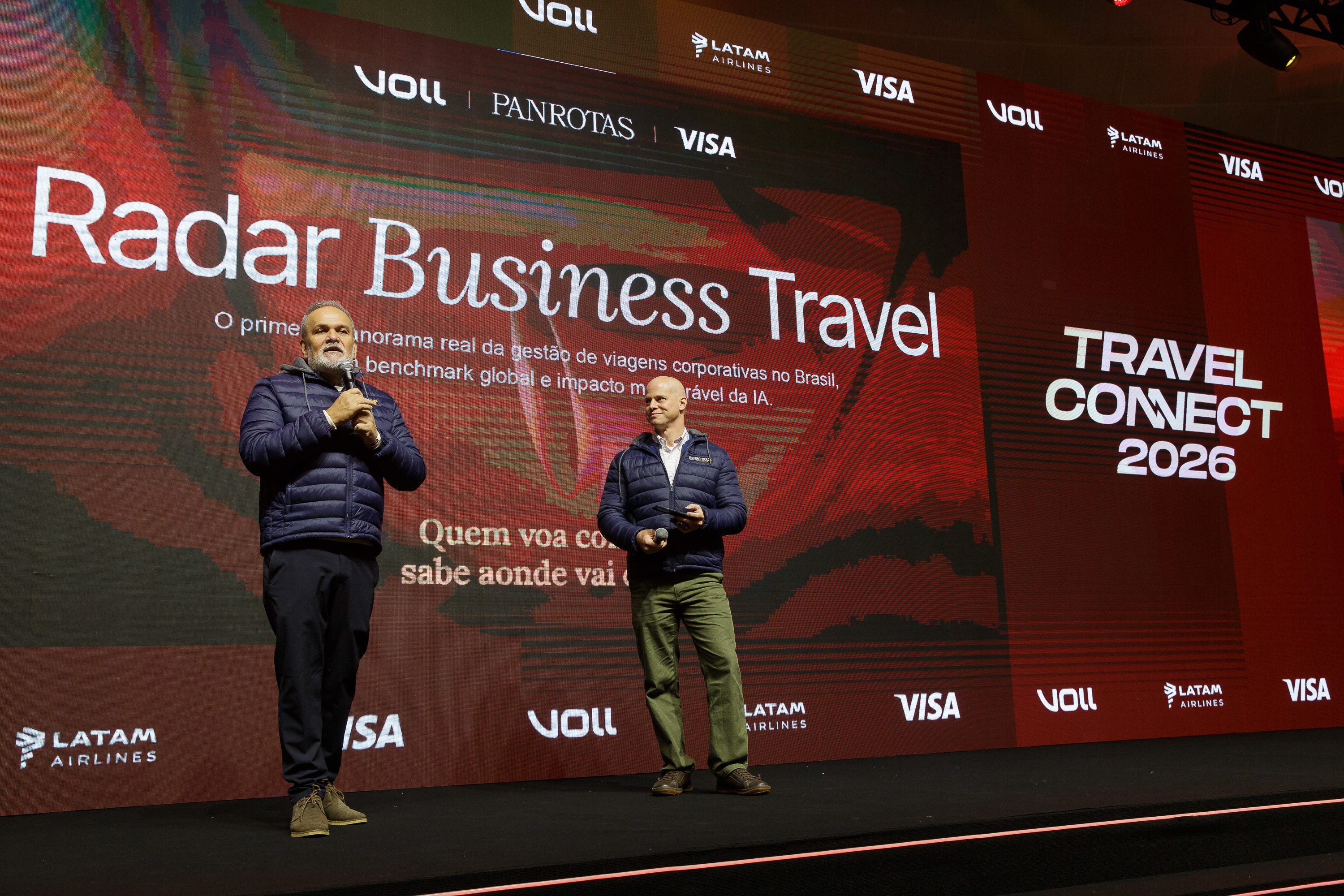
Policy compliance climbed from 57.7% to 59.1%. Digital self-service, travelers booking through the platform instead of a back office, rose from 85.8% to 89.7%, which is the plumbing that makes the first two measurable at all. This is the same base behind the Radar Business Travel study we publish with Visa and Panrotas.
None of those shifts is dramatic on its own, and that is the entire point. Efficiency in corporate travel is not one heroic negotiation. It is a stack of small disciplines, each worth a point or two, compounding across every trip in the program. In a year when the fare did everything it could to raise the bill, those are the levers that separated the companies absorbing the increase from the ones amplifying it.
Efficiency is a lower cost per outcome, not a cheaper fare
Here is the reframe that ties all of this together, and the reason a record fare does not frighten a well run program. Efficiency in corporate travel is not the price of a ticket. It is the cost per business result the trip was meant to produce, the contract signed, the factory audited, the client kept, the investor won. Judge a program by the fare and you will chase a number you cannot control and miss the money you can. Judge it by cost per outcome and every lever above starts to pay: the knowledge, the planning, the data, the policy, the culture, the communication, the AI.
It also changes which trips happen at all. The programs handling this best are sending fewer but more decisive trips, the ones where the value waiting on the other end dwarfs any fare, and quietly declining the ones a video call would have settled just as well.
The fare will keep doing what fuel, the exchange rate and airline capacity tell it to do, and it will keep being volatile, and R$776.87 will not be the last uncomfortable headline this year. That was never the number worth managing. The ticket got more expensive. The trip did not have to. The companies that understand the difference are the ones quietly absorbing a two-year high in one of their biggest cost lines while their competitors are still staring at the fare and wondering why shopping harder stopped working.
About me

I am an entrepreneur with over 20 years of experience at the intersection of tourism and technology. I am co-founder and Chief Business Officer of VOLL, the largest mobile-first corporate travel and expense management platform in Latin America, where I lead the commercial strategy behind our AI adoption.
A first-cohort graduate of The AI-Powered Organization at Stanford Graduate School of Business and a Marketing specialist from Fundação Dom Cabral, I serve on the Tourism Council of FecomércioSP and on the Executive Council of the Latin American Association of Corporate Events and Travel Management (Alagev). I write and speak about innovation, digital transformation, entrepreneurial leadership, and the future of corporate travel.